
Most small businesses don’t fail because the owner lacks passion or expertise. They’re more likely to stall because the work becomes a confusing maze: tasks live in people’s heads, customers get different experiences depending on who answers the email, and growth feels like adding stress rather than adding capacity.
That’s exactly where process architecture helps. It’s not a corporate buzzword. It’s simply a clear, practical way to organise all the processes in your business so you can improve the right things, in the right order, without drowning in documentation.
What process architecture actually means (in plain English)
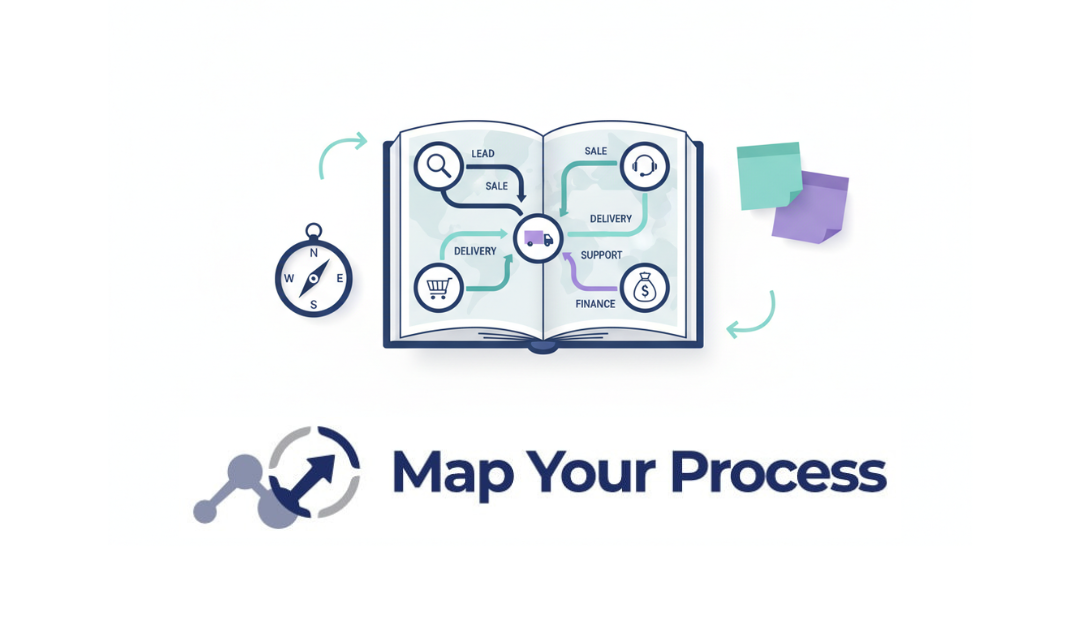
If process mapping is drawing one route on a map, process architecture is the whole atlas.
It’s a simple structure that answers:
- What are the main “value streams” (the big journeys that deliver outcomes to customers)?
- What supporting processes make those journeys possible?
- Who owns each process?
- Where do handoffs happen between people, tools, or teams?
You don’t need fancy software. A whiteboard, a spreadsheet, or a basic diagram tool is enough.
The 3 layers you can use to organise your business
A helpful way to build process architecture is to think in three layers. My advice is, keep it simple, and you’re far more likely to actually use it.
1) Customer-facing (core) processes
These are the processes that directly create and deliver what customers pay for.
Examples:
- Lead to customer (marketing + sales)
- Order to delivery (fulfilment)
- Support to resolution (customer service)
2) Enabling processes
These don’t directly create the product/service, but they make the core processes work.
Examples:
- Hiring and onboarding
- Training and knowledge management
- IT setup and access
- Supplier management
3) Governance processes
These keep the business safe, consistent, and legally/financially sound.
Examples:
- Finance and invoicing
- Data protection and security
- Quality checks
- Risk and compliance (at the level you need)
The point isn’t to build a perfect model. The point is to stop treating your business like a pile of unrelated tasks.
A practical example: a service business that’s “busy but stuck”
Let’s say you run a small service business: you sell a package, you deliver it, you invoice, and you support clients.
You might think your biggest issue is marketing. But when you step back and look at your process architecture, you notice something:
- Sales is generating leads
- Delivery is inconsistent because each project is run differently
- Invoicing is delayed because details are missing
- Support is reactive because expectations weren’t set clearly at the start
So the real bottleneck isn’t “more leads.” It’s the handoffs between sales, delivery, invoicing, and support.
Process architecture makes that visible. And once you can see it, you can fix it.
How process architecture helps you scale (without hiring too early)
Scaling isn’t just “more customers.” It’s more customers with the same or better experience, without the founder becoming the emergency services.
Process architecture helps you scale because it:
- Reduces decision fatigue: people know what happens next and where to find the answer.
- Creates repeatability: you can deliver the same quality without reinventing the wheel.
- Improves onboarding: new team members learn the business faster.
- Makes improvement targeted: you stop “fixing everything” and focus on the processes that drive results.
A simple test: if you were off for two weeks, would the business run smoothly—or would it wobble?
If it wobbles, you don’t need more hustle. You need clearer processes.
A simple way to build your process architecture in one afternoon
Here’s a practical approach that works for micro and small businesses.
Step 1: List your main outcomes
Write down the outcomes your business must reliably deliver.
Examples:
- Turn interest into qualified leads
- Convert leads into paying customers
- Deliver the service/product
- Get paid
- Retain customers and generate referrals
Step 2: Group them into 5–8 “big processes”
Aim for a short list you can hold in your head.
A common set:
- Marketing
- Sales
- Delivery/Fulfilment
- Customer Support
- Finance
- People (hiring/training)
- Systems/Tools
- Strategy/Improvement
Step 3: Identify the handoffs
For each big process, ask:
- What triggers this process to start?
- What is the output at the end?
- Who needs that output next?
This is where most friction lives.
Step 4: Pick one process to map properly
Don’t map everything. Choose the one that:
- causes the most delays,
- creates the most customer complaints,
- or eats the most founder time.
Then map that process end-to-end.
Step 5: Assign a “process owner”
Even if it’s just you for now, make it explicit. Ownership prevents the “everyone thought someone else was doing it” problem.
What to avoid (so this doesn’t become paperwork)
Process work can become a time sink if you overcomplicate it. Avoid these traps:
- Mapping for the sake of mapping: only map what you plan to use and improve.
- Writing a novel: a process map should be understandable in minutes.
- Ignoring reality: document what actually happens, then improve it.
- No review rhythm: if you never revisit it, it becomes shelfware.
Keep your process architecture lightweight. It’s a tool, not a trophy.
Your next step: build clarity before you build complexity
If you want your business to grow, you need a clear view of how work flows from “customer asks” to “customer gets value.” Process architecture gives you that view.
Once you’ve got it, process mapping becomes easier, improvement becomes focused, and scaling becomes less chaotic.
If you want help mapping your processes in a simple, practical way (without jargon or corporate fluff), talk to Map Your Process. We’ll help you get clarity fast, prioritise what to fix, and build a business that runs smoothly—even as you grow.