
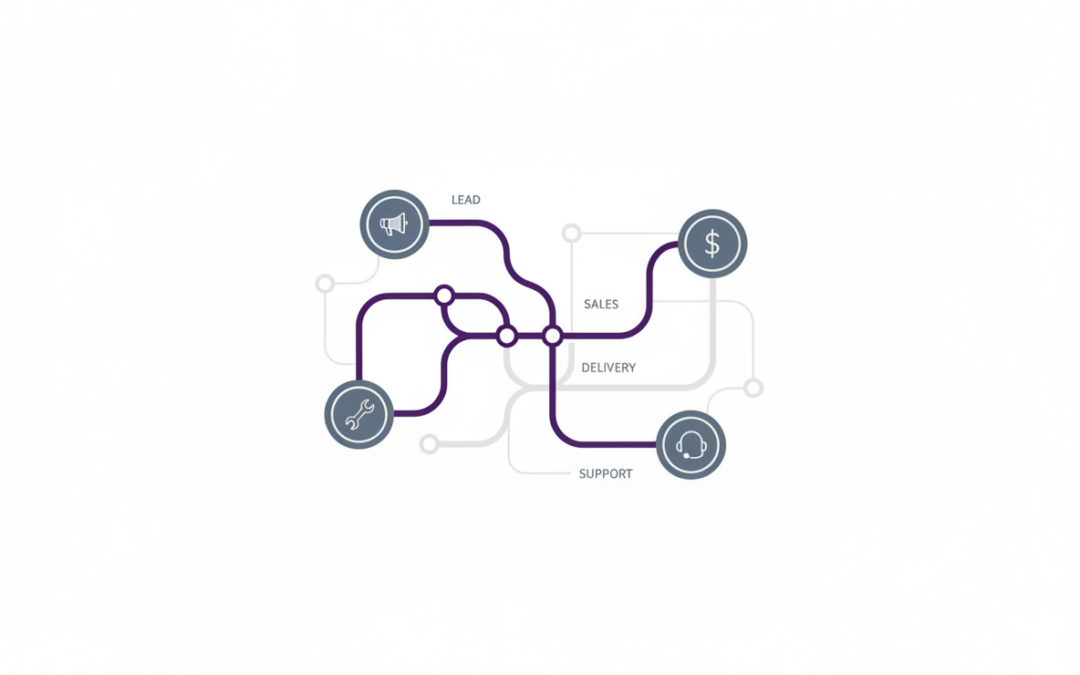
Most growing businesses will suffer from some form of failure because the bridge we’re discussing in this article is simply missing. These businesses don’t fail because their people don’t work hard. They struggle because the work doesn’t connect.
You’ve got a strategy in your head, a team doing their best, and a customer who expects consistency. But in the middle there’s often a gap: no shared picture of how the business actually runs. That’s where process architecture comes in.
Process mapping shows you how work gets done. Process architecture shows you how all the work fits together. If you want to scale without chaos, this “big picture” view is one of the most practical tools you can build.
What process architecture actually is (in plain English)
Process architecture is a simple way to organise your business processes into a clear structure.
Think of it like a map of a city:
- The city is your business.
- The main roads are your end-to-end processes (like “Order to Cash” or “Hire to Retire”).
- The side streets are the smaller processes and procedures that support the main roads.
- The street signs are your roles, rules, templates, and systems.
Instead of having random documents scattered across folders (or worse, only in people’s heads), you create a shared view that answers:
- What are the key processes that run this business?
- How do they connect?
- Who owns what?
- Where are the handoffs and risks?
This isn’t about creating a huge corporate manual. It’s about making the business easier to run.
The symptoms that tell you you need it
If any of these sound familiar, process architecture will help.
- You keep solving the same problems again and again
- “It depends who does it” is the normal answer
- New staff take too long to get up to speed
- You can’t confidently delegate because quality drops
- You’ve got tools and software, but work still feels messy
- Customers get different experiences depending on the day
These are common growing pains. The fix usually isn’t more effort. It’s more clarity.
A practical way to build your process architecture (without overthinking it)
Here’s a straightforward method you can use in a small business without getting bogged down.
1) Start with your customer journey
List the big stages a customer goes through with you. For example:
- Marketing (they find you)
- Sales (they decide)
- Delivery (you do the work)
- Support (you help them succeed)
- Retention (they come back)
This gives you a natural “spine” for your architecture.
2) Add the internal support processes
Now list the processes that keep the business running behind the scenes:
- Finance and invoicing
- Hiring and onboarding
- Supplier management
- IT and tools
- Compliance (if relevant)
These don’t always touch the customer directly, but they affect speed, quality, and risk.
3) Name your end-to-end processes
Keep the names simple and action-based. Examples:
- Lead to Customer
- Customer Onboarding
- Service Delivery
- Issue to Resolution
- Quote to Invoice
If you’re arguing about names, you’re probably going too deep too soon. Pick something “good enough” and move on.
4) Assign a process owner for each
A process owner isn’t necessarily the person doing all the work. They’re the person responsible for:
- Keeping the process clear and up to date
- Noticing issues and improving it
- Making sure handoffs work
In a small business, one person may own several processes. That’s fine.
5) Create a one-page visual
This is the key deliverable.
A simple one-page diagram (even in PowerPoint, Miro, or a whiteboard photo) that shows:
- Your main processes across the top
- Your support processes underneath
- The flow from lead to delivery to support
You can refine it later. The point is to make it visible.
A real-world example: the “handoff” problem
Let’s use a practical example most service businesses recognise.
You’ve got a sales conversation. The client says yes. Then the work starts.
Where things often go wrong is the handoff between sales and delivery:
- The salesperson promises something that isn’t in the standard service
- The delivery team doesn’t get the right information
- The client repeats themselves three times
- Deadlines slip because nobody is sure what “done” looks like
Process architecture helps because it forces you to define the connection between:
- Sales process (what gets agreed)
- Onboarding process (what gets captured)
- Delivery process (what gets done)
- Support process (what happens when something changes)
Once you can see these as connected parts of one system, you can fix the handoff with simple tools:
- A standard onboarding checklist
- A single “client brief” template
- A clear definition of what’s included vs optional
- A handover meeting agenda (15 minutes, not an hour)
No fancy software required. Just clarity.
How process architecture supports continuous improvement
Continuous improvement sounds like a big programme. In reality, it can be a small habit.
When you have process architecture, improvement becomes easier because:
- You know where a problem sits (which process)
- You can see who should own the fix
- You can prioritise improvements that affect customers most
A simple approach:
- Monthly: pick one process that causes friction and improve one step
- Weekly: capture “process pain” as it happens (quick notes)
- Daily: encourage the team to flag confusing steps without blame
Over time, small improvements compound. That’s a general observation across most businesses: consistent, small fixes beat occasional big “overhauls.”
The scaling benefit: fewer decisions, faster training, steadier quality
Scaling is often described as “getting more customers.” But operationally, scaling means:
- More work flowing through the same business
- More people involved in delivery
- More chances for inconsistency
Process architecture helps you scale because it reduces the number of decisions people have to make in the moment.
Instead of:
- “How do we do this again?”
You get:
- “Here’s the process, here’s the template, here’s the owner.”
That leads to:
- Faster onboarding for new staff or contractors
- More consistent customer experience
- Less dependency on one “key person”
- Easier delegation (because expectations are clear)
And importantly: it gives you a calm foundation to improve from.
Conclusion: build the map before you speed up
If your business feels busy but not always in control, don’t assume you need to work harder.
You may simply need a clearer map of how work flows through the business.
Process architecture is that map. It connects strategy to daily work, highlights handoffs, and gives you a practical structure for improvement.
If you want help creating a simple, usable process architecture (and mapping the processes that matter most), reach out to Map Your Process. We’ll help you turn “how we do things” into a clear system your team can follow and improve.