
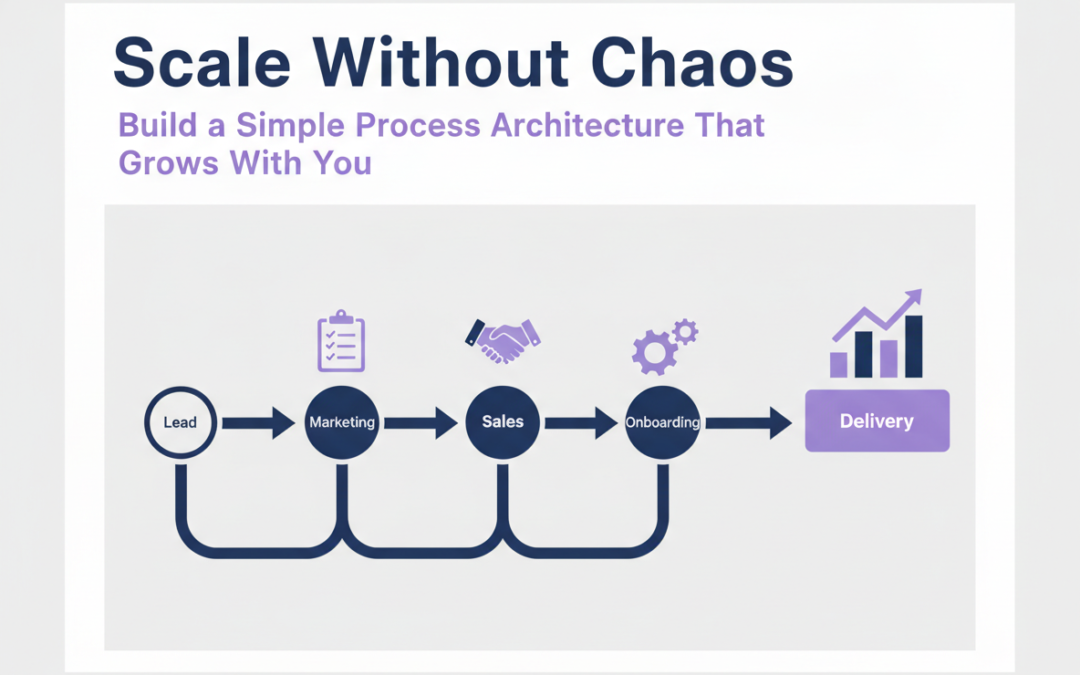
Simple Doesn’t Mean Less Effective!
Running a growing business can feel like spinning plates: every new customer, hire, or product adds another plate to keep in the air. It’s also the case that the daily noise of business battles often distracts us from doing behind-the-scenes tasks that, in fact, really matter for sustainable results and exceptional performance.
The good news is you don’t need a thick manual filled with corporate jargon to get control. You need a simple process architecture, a clear map of how your business works, end to end. Actually, if you haven’t done this before, then rather than document how it works, it would be more accurate to suggest you map how it should work or how you want it to work in the future!
What “process architecture” means (in plain English)
I make no apology for writing about what it means again; it really is that important that it’s a message worth repeating. Process architecture is just a tidy way of saying: the big-picture structure of your processes.
If process mapping is drawing a route on a map, process architecture is deciding:
- What the main “roads” are (your core processes)
- How they connect (handoffs between teams or tools)
- Where the side streets sit (supporting processes)
- What rules keep traffic moving (standards, templates, and ownership)
It’s not about documenting every tiny step. It’s about creating a shared view so everyone understands how work flows through the business.
The warning signs you’ve outgrown “winging it”
Most small businesses start with informal processes: people do what works, and the founder keeps everything in their head. That’s normal and, in many ways, the right way to run things in the chaotic early years of minimum viable offerings, assumptions, testing, learning, and adjusting to find the balance. The trouble starts when growth exposes the gaps.
Common signs you need a simple process architecture:
- Customers get different experiences depending on who helps them
- Tasks fall through the cracks during handovers
- You’re answering the same questions repeatedly
- New hires take too long to get up to speed
- You’re busy all day, but key work still doesn’t move forward
- You avoid delegating because “it’s faster if I do it myself”
These aren’t “people problems.” They’re usually process clarity problems.
The 4 layers of a simple process architecture
Here’s a practical way to structure your business processes without overcomplicating it. Think of it like zooming in on all levels of a map.
1) Value streams (the big promise to the customer)
A value stream is the end-to-end journey that delivers a result your customer cares about.
Examples:
- “Lead to Customer” (how you attract, sell, and onboard)
- “Order to Delivery” (how you fulfil and support)
- “Idea to Launch” (how you create and release new offers)
You might only have 2–5 value streams. That’s enough.
2) Core processes (the main stages)
Under each value stream, list the major stages. Keep it high level.
Example: Lead to Customer
- Marketing content and lead capture
- Lead qualification
- Sales conversation and proposal
- Closing and payment
- Onboarding and first delivery
At this level, you’re not writing instructions. You’re defining the “chapters” of the story.
3) Sub-processes (repeatable chunks of work)
Now identify the repeatable chunks that happen inside each stage.
Example: Onboarding and first delivery
- Welcome email sequence
- Client intake form and discovery
- Account setup (tools, access, permissions)
- Kick-off call agenda
- First deliverable checklist
This is where you start to get real value: you can delegate, automate, and improve.
4) Work instructions (only where needed)
Finally, decide where you truly need step-by-step instructions.
Good candidates:
- Anything that affects customer experience (onboarding, support)
- Anything that affects compliance or risk (payments, data handling)
- Anything a new team member must do the first time correctly
Everything else can stay lighter—checklists, templates, or short notes.
A practical example: scaling a service business without losing quality
Let’s say you run a small consultancy or agency. You’ve grown from 5 to 20 clients. You’re now juggling delivery, admin, and sales.
Without process architecture, you might have:
- Different onboarding steps for different clients
- Proposals stored in random places
- Delivery depending on who remembers what
- Support requests arriving through email, WhatsApp, and DMs
With a simple process architecture, you create one clear flow:
- Lead capture: all enquiries go into one place (a form, CRM, or shared inbox)
- Qualification: a short checklist decides if the lead is a fit
- Proposal: one template with optional sections (so it’s consistent but flexible)
- Onboarding: one standard welcome process with a clear timeline
- Delivery: a weekly rhythm (what happens every week, what gets reviewed)
- Support: one channel and one response standard
Notice what’s missing: a 50-page document. The goal is clarity, not bureaucracy.
How to build your process architecture in one afternoon
You can quickly create a first version. Here’s a simple approach.
Step 1: List your 3–5 “must-not-fail” outcomes
Ask: what outcomes keep the business alive?
Examples:
- Consistent lead flow
- Smooth onboarding
- Reliable delivery
- Fast issue resolution
- Accurate invoicing and cash collection
Step 2: Map the end-to-end flow for each outcome
Use a whiteboard, paper, or a simple diagram tool. Start with:
- Trigger (what starts the process)
- Key stages (3–7 stages)
- Output (what “done” looks like)
Step 3: Identify the handovers
Most problems happen at handovers. Mark where work moves between:
- People (sales to delivery)
- Tools (form to spreadsheet)
- Channels (email to project management)
If you fix handovers, you fix a lot.
Step 4: Assign ownership
Every core process needs an owner. Not necessarily the person doing all the work—just the person responsible for keeping it healthy.
Ownership means:
- The process is documented enough to run
- Improvements are captured
- Changes are communicated
Step 5: Create “minimum viable documentation”
Aim for the least documentation that still gives you control:
- A one-page map of each value stream
- A checklist for the key sub-processes
- Templates for repeatable outputs (proposal, onboarding email, weekly update)
If you can hand it to someone else and they can run it, you’ve won.
The hidden benefit: process architecture makes improvement easier
Continuous improvement doesn’t have to mean constant change. In fact, the best improvement is often small, steady, and focused.
When you have a process architecture, you can improve like a pro:
- You know where the problem sits
- You can test changes in one part without breaking everything
- You can measure progress using simple signals (fewer errors, faster cycle time, fewer customer complaints)
A general observation: businesses that grow smoothly tend to have clear ways of working, even if those ways are simple.
Conclusion: scale with clarity, not chaos
If you’re aiming to grow, you don’t need to work harder; you need work to flow better. A simple process architecture gives you a shared map of the business, so you can delegate with confidence, onboard faster, and maintain consistent quality as you scale.
If you’d like help mapping your core processes and building a simple process architecture that fits your business (without jargon or overengineering), get in touch with Map Your Process. We’ll help you turn “how we do things” into a clear, workable system your team can actually follow.