
Growing a business is exciting until the day you realise you’re spending more time fixing avoidable problems than serving your ideal customers. If your team is asking the same questions, work is getting “stuck” in the same places, or quality is slipping, it’s rarely solely a people problem. You can usually find a process problem hiding in the long grass, so your attention is focused on the people because they are in plain sight.
The good news, and the one thing we have made it our mission to spread the word about, is this: you don’t need a massive “transformation programme” to get control. No, all you need is a clear process architecture, a simple map of how your business works, so you can improve the right things in the right order.
What process architecture actually means, no smoke and mirrors
Process architecture is a structured way to describe your business as a set of connected processes.
Think of it like a town map:
- The whole town = your business
- Main roads = the big end-to-end processes (how value is delivered)
- Side streets = supporting processes (finance, HR, IT, admin)
- House numbers = specific tasks and work instructions
When you only document tasks (“click this, email that”), you miss the bigger picture. Process architecture gives you that bigger picture so you can see how work flows across teams, systems, and handoffs.
The four layers that make scaling easier
You can keep this simple by using four layers. You don’t need over-engineered solutions; start with the intention of doing the best you possibly can for your business, and seek out a specialist, or, if you want to do it yourself, start with a whiteboard, a slide, or a shared doc.
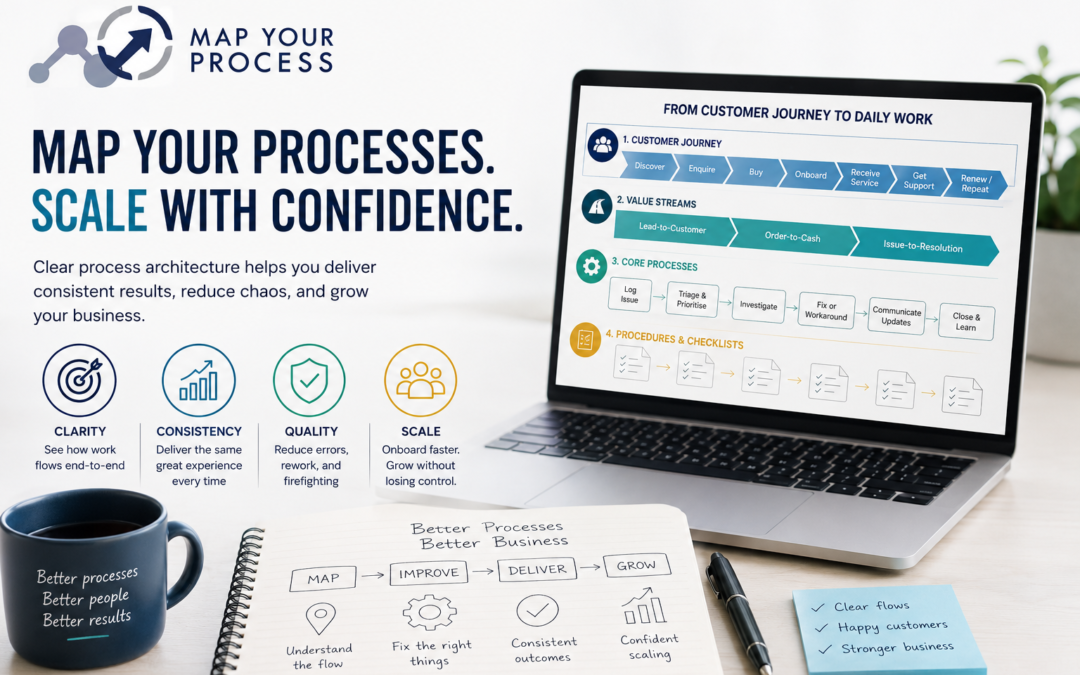
1) Customer journey (what the customer experiences)
Start with the customer’s view. Typical stages might be:
- Discover
- Enquire
- Buy
- Onboard
- Receive service
- Get support
- Renew/repeat
This keeps your process work grounded in what actually matters: customer outcomes.
2) Value streams (how you deliver value end-to-end)
A value stream is the end-to-end flow that turns demand into delivery. Examples:
- Lead-to-customer (sales)
- Order-to-cash (delivery + invoicing)
- Issue-to-resolution (support)
If you’re scaling, these are the “main roads” you want to keep clear.
3) Core processes (the repeatable chunks)
Within each value stream, list the core processes. For example, inside Issue-to-resolution, you might have:
- Log the issue
- Triage and prioritise
- Investigate
- Fix or workaround
- Communicate updates
- Close and learn
4) Procedures and checklists (how work is done today)
This is where templates, scripts, checklists, and work instructions live. Keep them short and usable. If nobody uses it, it’s not a process, it’s paperwork.
A practical example: scaling a service business without losing quality
Let’s say you run a small agency or consultancy. You’re getting more leads, but delivery is inconsistent. Some clients love you; others feel ignored.
Instead of “working harder,” map one value stream: Client onboarding to first delivery.
A simple process map might show:
- Sales handover (what was promised, key dates, risks)
- Kick-off call (goals, success measures, stakeholders)
- Access and assets (logins, brand guidelines, content)
- Plan and timeline (milestones, responsibilities)
- First deliverable (review, approval, release)
Now you can spot common failure points:
- Sales promises aren’t captured clearly
- Access requests happen too late
- Timelines aren’t agreed in writing
- Reviews are ad hoc, so rework increases
Once you can see it, you can fix it.
How to build your process architecture in one afternoon
Here’s a lightweight approach that works well for small, rapidly growing businesses.
Step 1: Choose your “north star” process
Pick one end-to-end flow that, if improved, would remove the most pain. Common picks:
- Lead-to-sale
- Sale-to-delivery
- Delivery-to-invoice
- Support-to-resolution
Step 2: Map the flow at a high level (7–12 steps)
Keep it simple. Use verbs. Focus on handoffs.
A good test: could a new team member understand the flow in five minutes?
Step 3: Add roles and handoffs
Write who owns each step (not “everyone”). Handoffs are where delays and misunderstandings hide.
Step 4: Identify the “moments that matter”
These are points where mistakes cause outsized damage:
- Customer expectations are set
- Money is committed
- Work is approved
- A deadline is promised
- A complaint is handled
Step 5: Create one checklist per moment that matters
Not a 40-page manual—just a short checklist.
Example: Kick-off call checklist
- Confirm goals and success measures
- Confirm scope (what’s in/out)
- Confirm stakeholders and decision-makers
- Confirm timeline and key dates
- Confirm communication rhythm
- Confirm next step and owner
Step 6: Review weekly for 20 minutes
Scaling businesses don’t “set and forget” processes. They build a habit of small improvements.
Ask:
- What slowed us down this week?
- What caused rework?
- What did customers complain about?
- What did we do twice?
Then make one change. Small, consistent improvements beat big, rare overhauls.
Common mistakes (and how to avoid them)
Mistake 1: Mapping everything at once
If you try to map the whole business in week one, you’ll burn out. Start with one value stream.
Mistake 2: Confusing documentation with improvement
A map is not the goal. Better outcomes are the goal: faster delivery, fewer errors, happier customers, and less firefighting.
Mistake 3: Making processes too complicated
If it needs training to understand, it’s probably too complex. Use plain English. Use examples. Keep steps short.
Mistake 4: Ignoring the “why”
People follow processes when they understand the purpose. Tie each process to a customer outcome or business result.
A simple way to know you’re ready to scale
You’re ready to scale when:
- Your best results are repeatable, not accidental
- A new person can deliver “good enough” results quickly
- Customers get a consistent experience
- Problems are spotted early, not at the end
That doesn’t require perfection. It requires clarity.
Conclusion: map the business you actually run
Process architecture isn’t about bureaucracy. It’s about making your business easier to run, so growth doesn’t feel like chaos.
If you can map how work flows end-to-end, you can improve the right steps, train people faster, and protect quality as demand increases.
Your Next Move
If you want help turning your business into a simple, scalable set of processes, without jargon or overcomplication—Map Your Process can help.
Bring one problem area (sales, onboarding, delivery, invoicing, or support). We’ll map the flow, identify the bottlenecks, and create practical checklists your team will actually use.