
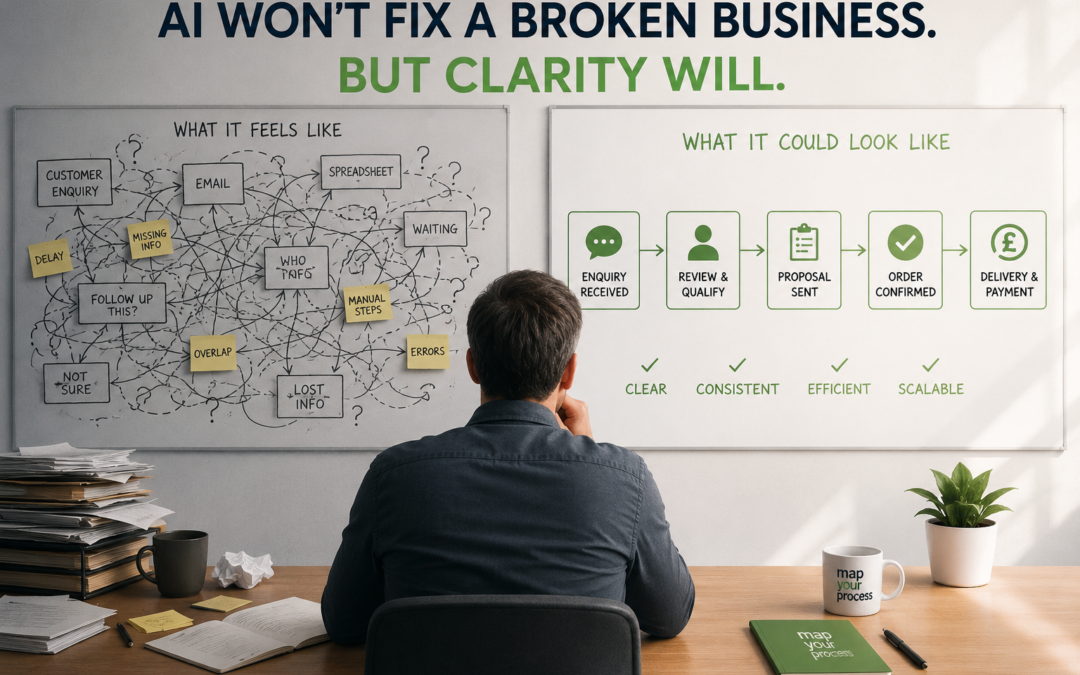
But It Will Show You Where the Cracks Are
Just take a look around; artificial intelligence is everywhere. Every week, another tool promises to save hours, automate admin, write your marketing, answer customer enquiries or manage your projects.
For small and medium-sized businesses, it’s exciting. It’s also becoming an expensive distraction. Many business owners are investing in new technology before they’ve taken the time to understand how their business actually works.
The result?
They automate confusion rather than remove it.
The real problem isn’t technology
Most growing businesses don’t have a technology problem.
They have a clarity problem. They don’t have a clear picture of how work moves through the business, so every improvement becomes guesswork.
People are busy; there’s no doubt. You can look around and see everyone is working hard. Customers are still being served. But behind the scenes…
- The same questions are being asked every week.
- Work gets stuck waiting for one person.
- Different team members complete the same task in different ways.
- Mistakes keep happening.
- Customers experience unnecessary delays.
- Nobody can explain exactly why.
When this happens, buying another piece of software rarely solves anything. It simply adds another layer of complexity.
AI only follows instructions
Artificial Intelligence is incredibly good at following patterns. The problem is that it can’t distinguish between a good process and a bad one.
If your quoting process already contains unnecessary steps, AI will complete them faster.
If your customer onboarding is confusing, AI will automate the confusion.
If information is stored in five different places, AI won’t magically organise your business for you.
Technology amplifies whatever already exists. That’s why some businesses see enormous improvements from AI while others wonder what all the fuss is about.
Before asking “What software should we buy?” ask a different question
Instead of asking:
“Which AI tool should we use?”
Try asking:
“How does this piece of work actually move through our business?”
- Where does it start?
- Who becomes involved?
- Where does it wait?
- Where do mistakes happen?
- Where do customers experience delays?
- Where do people regularly have to chase updates?
Those answers are usually worth far more than another software subscription.
Simplicity beats complexity
The businesses that grow successfully aren’t usually the ones with the most technology. They’re the ones where everyone understands how work flows.
- People know what happens next.
- Responsibilities are clear.
- Information is easy to find.
- Problems become obvious before they become expensive.
Once that foundation exists, introducing automation becomes far easier because you’re improving a process that already works.
Technology should support your business—not define it
There’s absolutely a place for AI. Used well, it can save time, improve consistency and remove repetitive work.
But technology should be the final step in improving a business, not the first.
When you understand how work moves through your organisation, every decision becomes easier. You know where improvements will have the biggest impact. You know which activities genuinely need automation.
Most importantly, you avoid spending money solving the wrong problem.
Final thought
Before investing in another platform, another subscription or the latest AI tool, spend some time understanding how your business really works. You might discover that the biggest opportunity isn’t buying new technology at all.
It’s removing the friction that’s been slowing your business down all along. Because when your processes are clear, everything else—including AI—becomes far more effective.
Where would you start?
If you’ve recognised your own business in this article, don’t rush out and buy another piece of software. Instead, pick just one process.
Perhaps it’s how you handle enquiries, onboard new customers, deliver projects or manage invoices.
Ask yourself a simple question:
“If a new member of staff had to follow this process tomorrow, could they do it consistently without asking someone for help?”
If the answer is no, you’ve probably found your next improvement opportunity.
Small improvements, made in the right place, often have a bigger impact than major investments in new technology. If you’d like an independent view of where your biggest opportunities lie, we’d be happy to have a conversation.