
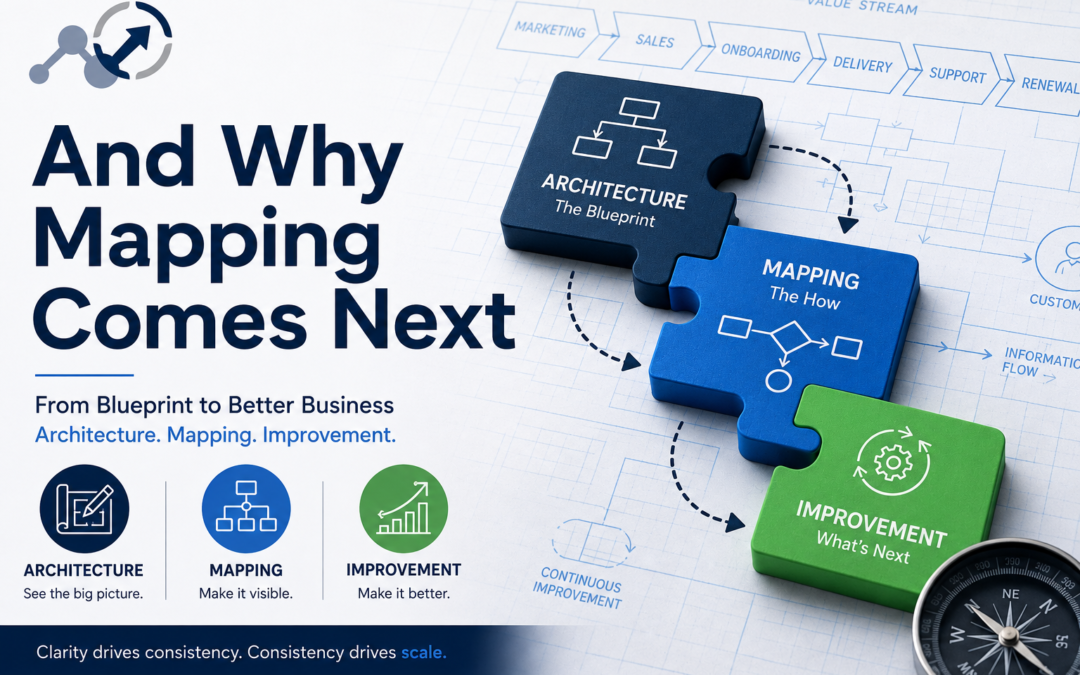
And Why Mapping Comes Next
Most businesses on the path of controlled growth and creating lasting scale don’t struggle because they have bad ideas. They struggle because growth turns “what we do” into “how we do it”, and nobody can explain the “how” consistently anymore.
If you’re scaling, you’ve probably felt it: more customers, more staff, more tools… and suddenly more confusion. The fix isn’t working harder. It’s building clarity into the business, on purpose, through process architecture, process mapping, and continuous improvement.
1) The hidden cost of “we’ll figure it out”
In the early days, there’s little doubt speed matters more than structure. You make decisions quickly, everyone wears multiple hats, and the business runs on conversations. This does cause a little chaos, but then I would argue that a little chaos is expected when businesses of any size or stage of development are entering and navigating their way through a creative phase, maybe a new project, product or expansion of some description.
But as you grow beyond the initial creative phases, that same approach creates friction:
- Tasks get done differently depending on who’s doing them
- Customers get inconsistent experiences
- Mistakes repeat because no one owns the “right way”
- Leaders become bottlenecks because everything needs their input
- New hires take too long to get up to speed
None of this means your team is failing. It usually means your business has outgrown “tribal knowledge” (the stuff everyone sort of knows but nobody has written down).
Clarity is what unlocks scale. And clarity is built through process.
2) Process architecture: the blueprint before the floorplan
Let’s keep this simple:
- Process architecture is the big-picture blueprint of how your business works.
- It shows the major “value streams” (how work flows from enquiry to delivery to retention), and how departments or functions connect.
Think of it like designing a house:
- Architecture decides where the rooms go and how people move through the space.
- You wouldn’t start choosing tiles before you know where the kitchen is.
In business terms, process architecture helps you answer:
- What are the core processes that drive revenue and customer satisfaction?
- Where do handoffs happen between roles or teams?
- Which processes are “front stage” (customer-facing) vs “back stage” (internal)?
- Where are the biggest risks, delays, or duplicated effort?
Practical example:
A service business might have a high-level architecture like:
- Marketing → Sales → Onboarding → Delivery → Support → Renewal/Referral
If those links aren’t clear, you’ll feel it as dropped leads, messy onboarding, scope creep, and inconsistent delivery.
At Map Your Process, we often start here, because once the blueprint is clear, mapping becomes faster and far more useful.
3) Process mapping: turning “how we do it” into something scalable
Process mapping is the step-by-step view of how work actually gets done. It takes the blueprint and turns it into an operational reality.
A good process map makes work:
- Repeatable
- Trainable
- Measurable
- Easier to improve
And importantly, it separates:
- What should happen
from - What actually happens
That gap is where most of the waste and frustration lives.
Practical example:
Let’s say you run a consultancy and onboarding feels chaotic. A mapped onboarding process might include:
- Confirm scope and deliverables
- Send welcome email + next steps
- Collect required info (questionnaire, access, documents)
- Book kickoff call
- Create project workspace and timeline
- Confirm communication rhythm and responsibilities
Once mapped, you can spot issues quickly:
- Are we asking for the same info twice?
- Are we waiting days for approvals because nobody owns the next step?
- Are we relying on one person’s memory to trigger the next action?
Mapping doesn’t slow you down. It removes the need to constantly “re-decide” how work gets done.
4) Continuous improvement: small upgrades that compound
Once your processes are visible, improvement becomes practical rather than theoretical.
Continuous improvement isn’t about perfection. It’s about building a habit of making things slightly better, regularly, based on what you’re learning.
A simple rhythm that works for many growing businesses:
- Review one key process each month (or quarter)
- Ask the team: “Where do we lose time? Where do we get stuck? What causes rework?”
- Make 1–3 changes only (keep it manageable)
- Update the process map and communicate the change
General observation (no hard stats):
Most businesses don’t need a dramatic transformation to see results; they need consistent friction removal. Small improvements compound, especially when your team is growing.
5) How Map Your Process helps you scale with clarity (without the jargon)
At Map Your Process, the focus is straightforward: make your business easier to run, grow, and improve.
That usually means helping you:
- Create a clear process architecture (the “what connects to what”)
- Map key processes that impact customers, revenue, and delivery
- Identify bottlenecks, duplication, and risk points
- Build a simple improvement plan your team can actually follow
The goal isn’t to produce a pretty diagram that sits in a folder. The goal is to create a working system that supports growth.
If you want scale, you need consistency.
If you want consistency, you need clarity.
And if you want clarity, you need your processes visible and owned.
Conclusion: scale is built, not hoped for
Scaling shouldn’t feel like holding the business together with late nights and constant firefighting. With the right process architecture, clear process maps, and a continuous improvement habit, growth becomes something you can manage—rather than something that manages you.
Your Next Step
If you’re ready to create clarity and build a business that scales without chaos, talk to Map Your Process. We’ll help you design the blueprint, map what matters, and put improvement on a practical track—so your business can grow with confidence.
In Our Next Episode…
We will focus on continuous improvement in real life: how to run a simple monthly “process review” meeting that improves one workflow at a time without overwhelming the team.
If this article has left you wanting more, we would welcome the opportunity to talk with you, share ideas, and explore the possibilities tomorrow could bring…