
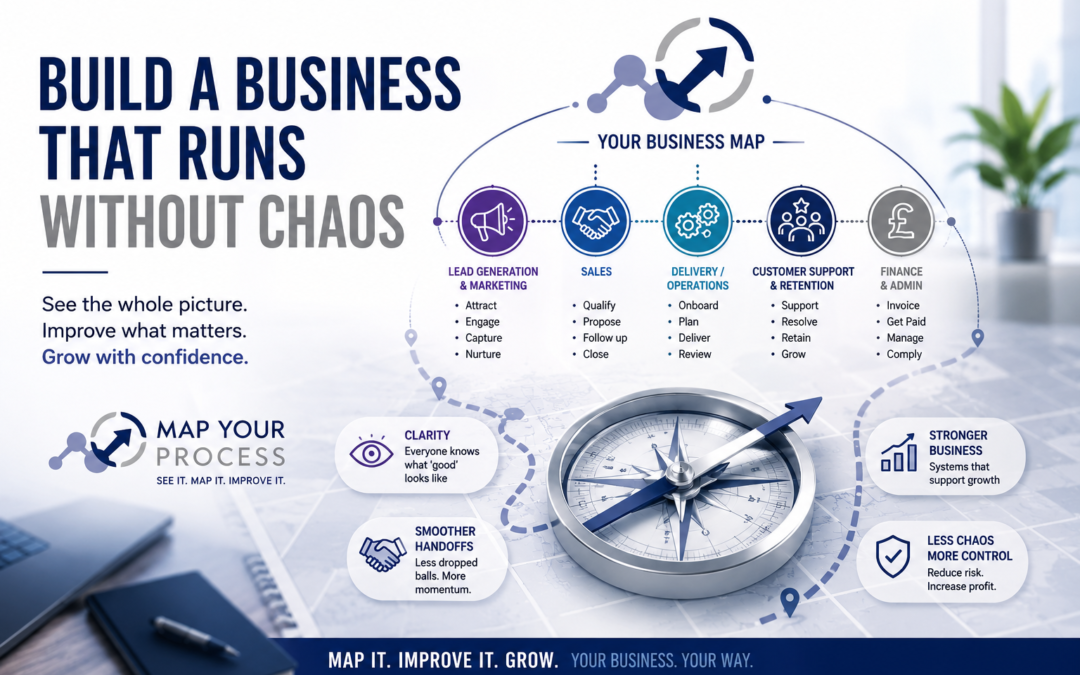
It’s all about Process Architecture
Most growing businesses can’t be criticised for the amount of time and effort they put into their development; there’s no doubt they are working hard. They struggle because the business is being held together by memory: “I know how we do that,” “Sarah handles it,” “It’s in that spreadsheet somewhere.”
Process architecture is the plain-English fix. It’s not a corporate exercise. It’s simply a clear map of what your business does, how the work flows, and where each process sits, so you can improve, delegate, and scale without chaos.
What process architecture actually means (in plain English)
If process mapping is drawing the steps of one process (like onboarding a new client), process architecture is the bigger picture: the “map of maps.”
Think of it like a town map:
- Process architecture is the whole town: neighbourhoods, main roads, and how everything connects.
- Process maps are the individual streets: the step-by-step route to get somewhere.
A simple process architecture answers questions like:
- What are the main areas of our business (sales, delivery, finance, support)?
- What are the key processes inside each area?
- Which processes connect to others (handoffs)?
- Which ones are critical, risky, or frequently broken?
You don’t need special software to start. A whiteboard, a Google Doc, or a simple diagram tool is enough, but for those businesses that really want to embrace the significant and clear advantages to process mapping throughout their business, professional and focused support should never be dismissed too lightly.
The 5 “business neighbourhoods” most companies need
Most small businesses can start with five high-level areas. You can rename them to suit your world, but keep it simple.
- Lead generation & marketing: How people find you, trust you, and enquire.
- Sales: How you qualify, quote, follow up, and close.
- Delivery/operations: How you fulfil the service or deliver the product.
- Customer support & retention: How you handle issues, keep customers happy, and encourage repeat business.
- Finance & admin: How you invoice, get paid, manage suppliers, and stay compliant.
Now list your key processes under each. Keep it to 5–12 processes per area at first. If you list 40, you’re going into too much detail too early.
A practical example: a service business process architecture
Let’s say you run a small consultancy, agency, or professional service.
Lead generation & marketing
- Publish weekly content
- Capture leads (contact form/lead magnet)
- Book discovery calls
Sales
- Discovery call
- Proposal creation
- Follow-up and close
- Contracting and deposit
Delivery/operations
- Client onboarding
- Project planning
- Weekly delivery cycle
- Quality checks
- Project close-out
Customer support & retention
- Handling client questions
- Managing changes in scope
- Collecting testimonials
- Renewal / upsell conversations
Finance & admin
- Invoicing
- Payment chasing
- Monthly accounts review
- Supplier management
This is not “documentation for documentation’s sake.” It’s a working tool.
Once you can see the whole system, you can spot problems faster:
- “We’re great at marketing, but sales follow-up is inconsistent.”
- “Onboarding is different every time, so delivery starts messy.”
- “Invoices go out late, so cash flow is unpredictable.”
How process architecture helps you scale (without burning out)
Here’s the honest truth: you can’t scale a business that only works when you are present.
Process architecture helps because it:
- Creates clarity: everyone knows what ‘good’ looks like.
- Improves handoffs: fewer things fall between departments (or between you and a freelancer).
- Makes improvement easier: you can prioritise the 2–3 processes that will make the biggest difference.
- Reduces risk: if one person is off sick, the business still runs.
- Speeds up onboarding: new team members learn faster when the business’s “shape” is visible.
A useful way to think about it is this: process architecture turns your business from a set of heroic efforts into a repeatable system.
A simple 60-minute method to build your first process architecture
You can do this in one focused session. Don’t aim for perfection; aim for a version you can improve.
Step 1: Write your 5 business areas
Use the five neighbourhoods above, or your own.
Step 2: List your key processes under each
Ask: “If this process broke, would we feel it this week?” If yes, it’s key.
Step 3: Mark the top 3 pain points
Put a star next to the processes that:
- cause the most delays
- create the most customer complaints
- rely on one person’s memory
- regularly lead to rework
Step 4: Identify the handoffs
Handoffs are where work moves between people or stages. They’re often where things go wrong.
Examples:
- Marketing → Sales: enquiry comes in, but no follow-up happens.
- Sales → Delivery: proposal promises something delivery didn’t plan for.
- Delivery → Finance: work is done, but invoicing is delayed.
Step 5: Choose one process to map next
Pick the process that will reduce stress and increase consistency fastest. Often that’s:
- client onboarding
- sales follow-up
- weekly delivery cycle
- invoicing and payment chasing
Then create a simple process map (steps, owner, inputs/outputs). Keep it plain English.
Common mistakes (and how to avoid them)
Mistake 1: Going too detailed too soon. If you start with 200 steps, you’ll quit. Start at a high level, then drill down into the processes that matter.
Mistake 2: Making it a document nobody uses. If your process architecture lives in a folder and never gets updated, it becomes fiction. Treat it like a living map.
Mistake 3: Confusing “how we do it today” with “how we should do it” Start with reality. Then improve. A good process is built in iterations.
Mistake 4: Ignoring customer impact. When you improve a process, ask: “Does this make the customer experience smoother?” If yes, you’re on the right track.
Conclusion: build the map, then improve the route
Process architecture gives you the overview. Process mapping gives you the detail. Together, they help you build a business that runs consistently, without you having to hold everything in your head.
If you want to scale calmly, start by making the work visible.
Want help building a simple process architecture and mapping the processes that matter most?
Map Your Process can help you create a clear, practical view of your business processes, so you can improve what matters, delegate with confidence, and grow without chaos. Contact us today for a no-obligation chat about how we can support your mission…