
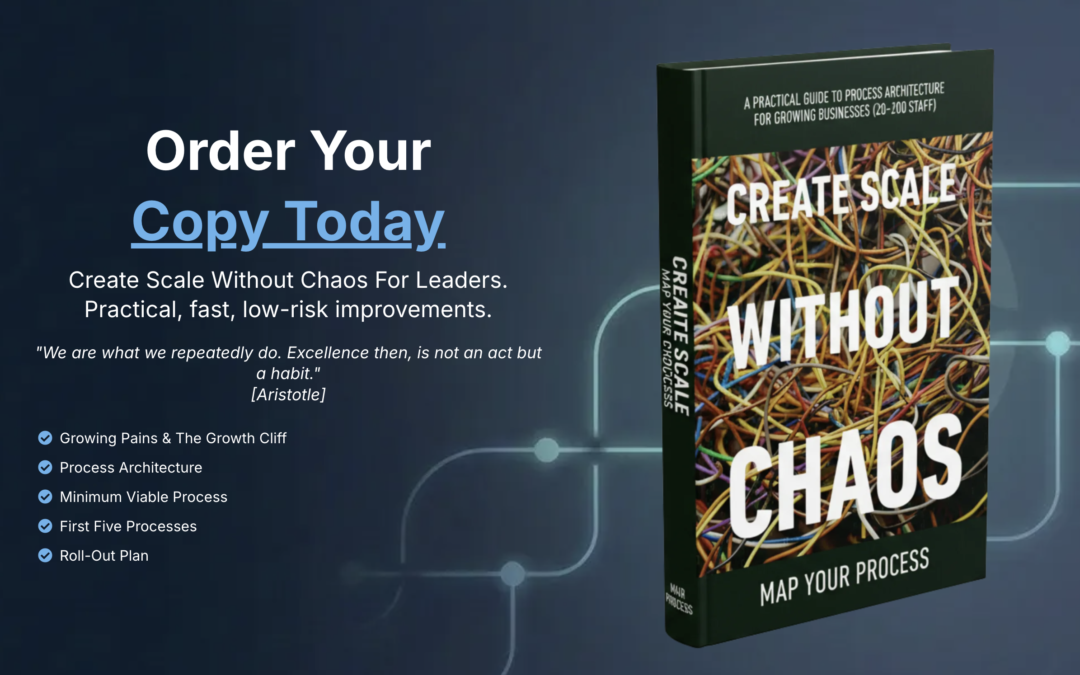
Introducing the new e-book from Map Your Process: Create Scale Without Chaos
Growth is supposed to feel like progress. More customers. More opportunities. More momentum.
But for a lot of businesses, there’s a point where growth stops feeling exciting and starts feeling messy.
Decisions take longer. Mistakes creep in. The “simple stuff” becomes hard work. Customers get different experiences depending on who they speak to. The team works harder, but it doesn’t always translate into better results.
That moment has a name: the Growth Cliff.
The problem isn’t winning customers — it’s delivering consistently
Most businesses don’t fail because they can’t attract customers. They struggle because they can’t deliver consistently as the business grows.
When delivery becomes inconsistent, everything else gets harder:
- Customer satisfaction becomes unpredictable
- Quality varies from person to person
- Risk increases (even if you can’t see it yet)
- Leaders start compensating with more checking, more chasing, and more “being involved in everything”
And that’s when chaos quietly becomes the operating system.
Why growth creates chaos (even in good businesses)
Here’s the frustrating part: these growing pains are predictable.
They can show up in a start-up, a micro business, or a more established company. They don’t care how talented your team is or how good your intentions are. They show up because growth adds complexity:
- More people
- More customers
- More services
- More moving parts
If the business doesn’t evolve how it works, the strain appears everywhere.
The fix isn’t “more effort” — it’s process architecture
When people hear the word process, they often think:
- Paperwork
- Red tape
- Someone telling them how to do their job
But a good process approach does the opposite.
It makes work easier, faster, and more consistent—without turning your business into a bureaucracy.
The key is understanding that process isn’t one thing. In growing businesses, several related ideas get mixed up, and that confusion creates friction. When you separate them properly, you can build a structure that supports growth instead of slowing it down.
That’s what we mean by process architecture: designing how work flows so the business can scale without relying on heroics.
The three pillars that make scale sustainable
As a business grows, the real challenge isn’t doing more work.
It’s doing the work the same way, to the same standard, every time—even when you add new people, new customers, and new services.
That’s where three practical ideas matter:
- Consistency: customers get a reliable outcome (not robotic behaviour)
- Control: you can manage risk and quality without micromanaging
- Auditability: you can prove what happened, when, and why—without creating a paperwork monster
When these three are in place, growth becomes calmer. Delivery becomes repeatable. And leaders get to lead again, instead of constantly firefighting.
Introducing the eBook: How to: Create Scale Without Chaos
If you’ve felt that “messy growth” phase creeping in—or you want to prevent it before it hits—our new eBook is designed to give you a clear starting point.
How to: Create Scale Without Chaos by Chris Batten & John Stanton is a brief, focused look at the predictable growing pains that show up as businesses grow, and how to start building the foundations that keep delivery consistent.
In the eBook, you’ll explore:
- What the Growth Cliff is and how to spot it early
- Why growth creates friction across the whole business
- How process architecture helps you scale without bureaucracy
- How to make consistency, control, and auditability practical (without micromanaging or drowning in paperwork)
Ready to grow without the chaos?
If you want growth that feels like progress—not pressure—this eBook will help you see what’s happening inside your business and what to do next.
Get your copy of How to: Create Scale Without Chaos today and start building the structure that supports sustainable growth.
Here’s how to order your copy https://marketing.mapyourprocess.co.uk/free-e-book-offer-page-page