
Use Process Architecture; it makes a real difference
When it comes to scaling your business, it should feel exciting. Too often it feels like an overwhelming task: more customers, more requests, more “quick fixes”… and suddenly the work that used to take an hour takes a day.
We see it all the time: when things start to get tough, frustrating or both, it’s usually not a people problem. It’s often a structure problem.
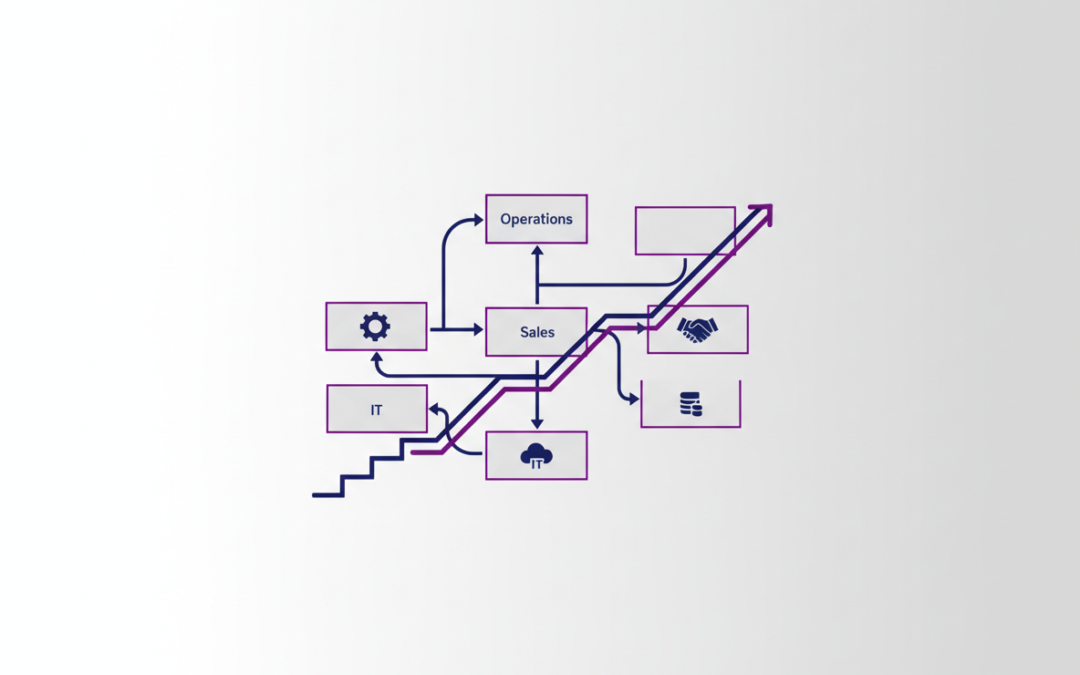
Process architecture is the simple, practical way to design how your business works so growth doesn’t create chaos. Think of it as a map of your business operations: the major processes, how they connect, and who owns what.
Process Architecture is a simple solution
Process architecture is nothing more than the “big picture” view of your business processes.
If process mapping is drawing the step-by-step route for one journey (like onboarding a new client), process architecture is the map of the whole transport system: the main lines, the stations, and how people move between them.
A good process architecture:
- Shows the core areas of your business (sales, delivery, finance, support, etc.)
- Defines the main processes in each area
- Clarifies handoffs (where work moves from one person/team to another)
- Helps you spot gaps, duplications, and bottlenecks
It’s not a 200-page manual. It’s a clear, usable overview that makes everything else easier.
The hidden cost of “we’ll just figure it out”
Most businesses scale on improvisation. That works… until it doesn’t.
Common symptoms you’ll recognise:
- Customers get different answers depending on who they speak to
- Work is stuck in someone’s head (and everything slows down when they’re away)
- You keep fixing the same issues because the root cause never gets addressed
- New hires take ages to become productive
- You’re busy all day, but the business still feels fragile
None of this means you’re doing anything wrong. It’s a normal stage of growth.
The shift is moving from heroic effort to repeatable systems.
The 6 building blocks of a simple process architecture
You can build a practical process architecture in a day or two (and refine it over time). Start with these six blocks.
1) Customer journey processes
These are the processes that directly touch the customer experience.
Examples:
- Lead capture and qualification
- Sales and proposals
- Onboarding
- Service delivery/fulfilment
- Customer support
- Renewals/retention
2) Product/service creation processes
This is how you create and improve what you sell.
Examples:
- Product development
- Content creation
- Quality checks
- Packaging and delivery standards
3) Operations processes
The “keep the lights on” work.
Examples:
- Scheduling
- Supplier management
- Tools and access
- Internal communication
4) Finance and compliance processes
These protect the business.
Examples:
- Invoicing and collections
- Expense approvals
- Refund handling
- Data protection basics
5) People and capability processes
Even if you’re a smaller business today, you’re building for the future.
Examples:
- Hiring and onboarding
- Training and role clarity
- Performance check-ins
6) Improvement processes
This is the “engine” that stops problems repeating.
Examples:
- Weekly review of issues and fixes
- Customer feedback loop
- Process change control (so updates don’t create confusion)
Put these blocks on one page. Under each, list your main processes. That’s your first draft architecture.
A practical example: the messy onboarding problem
Let’s say you run a service business and onboarding is getting messy.
What you see:
- Clients don’t know what happens next
- You chase information late
- Projects start with confusion
If you only map onboarding, you might improve the steps—but still get stuck because onboarding depends on other processes. With process architecture, you spot the connected pieces:
- Sales handoff (what information is captured before the sale closes)
- Contracting (who sends what, when)
- Payment setup (what triggers the project start)
- Delivery planning (how work is scheduled)
- Client communication standards (what “good” looks like)
Now you can fix the system, not just the symptoms.
A simple improvement could look like:
- A standard “handoff checklist” from sales to delivery
- A single onboarding email template with clear next steps
- A defined trigger: “Project starts when contract signed + first payment received + onboarding form completed”
No fancy software required—just clarity.
How process architecture helps you scale (without burning out)
When you have a clear process architecture, scaling becomes less stressful because:
- You can prioritise. You know which processes are core and which are supporting.
- You can delegate faster. People can see where their work fits and what “done” means.
- You reduce rework. Clear handoffs prevent “I thought you were doing that.”
- You improve consistently. You can choose one process per week/month to refine.
A useful mindset: you’re not building processes to control people. You’re building processes to free people—including you.
A quick-start exercise: your one-page process architecture
If you want to try this today, here’s a quick exercise.
Step 1: Draw six headings
Write these headings on a page:
- Customer journey
- Product/service creation
- Operations
- Finance/compliance
- People/capability
- Improvement
Step 2: List 3–7 processes under each
Keep it simple. Use plain language.
For example, under “Customer journey” you might write:
- Respond to enquiries
- Qualify leads
- Send proposals
- Onboard new clients
- Deliver service
- Handle support requests
Step 3: Mark your “pain points”
Put a star next to the processes that cause:
- Delays
- Complaints
- Stress
- Cashflow issues
- Repeated mistakes
Step 4: Pick one process to map next
Choose the one that will create the greatest relief or the greatest customer impact.
That’s where process mapping comes in: once you know the architecture, you can map the right process at the right time.
Your call to action: Map Your Process
If you’re ready to scale with more confidence (and less chaos), Map Your Process can help you build a clear, practical process architecture—and then map and improve the processes that matter most.
Start simple: one page, clear ownership, and one priority process to fix next.
Want help creating your one-page process architecture and choosing the best process to map first? Reach out to Map Your Process, and we’ll get you moving quickly, without jargon or overwhelm.