
When a business is small, you can “hold the process in your head.” When it grows, that same approach becomes the bottleneck. Work gets repeated, customers get different answers, and the team spends more time chasing information than delivering outcomes.
That’s where process architecture comes in. It sounds technical, but it’s simply a clear, practical way to organise how work gets done—so you can scale without adding chaos.
What process architecture actually means (no jargon)
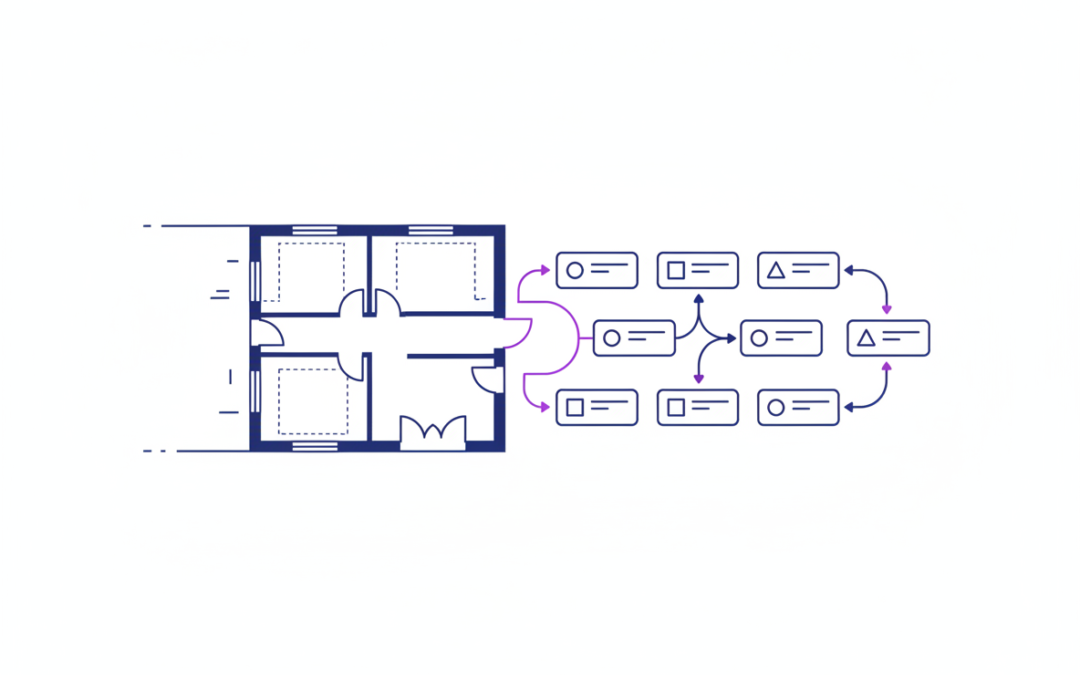
Process mapping is drawing one process. Process architecture is the big picture that shows how your key processes fit together.
Think of it like a house:
- A process map is one room (for example, “how we onboard a new client”).
- Process architecture is the floor plan (sales connects to onboarding, which connects to delivery, which connects to invoicing and support).
When you can see the floor plan, you stop fixing problems in isolation. You can spot where handovers break, where approvals slow things down, and where “quick fixes” create new issues downstream.
The four layers that keep scaling simple
Here’s a straightforward way to structure your business processes without overcomplicating them. You can sketch this on a whiteboard in 20 minutes.
- Customer-facing journey: What the customer experiences end-to-end (enquiry → purchase → delivery → support → renewal).
- Core delivery processes: The work that creates the outcome you sell (service delivery, fulfilment, project delivery, production).
- Support processes: The things that keep the engine running (finance, admin, HR, IT, documentation).
- Management and improvement: Planning, quality checks, performance reviews, and deciding what to improve next.
If you’re a smaller business, you may be one person covering all four layers. That’s fine. The point is clarity: when something breaks, you’ll know which layer it belongs to and what it’s connected to.
A practical example: why “onboarding” keeps going wrong
Let’s use a common scenario for service businesses.
You map your onboarding process, and it looks fine:
- Client signs proposal
- Invoice sent
- Welcome email sent
- Kick-off call booked
- Access granted to the shared folder
- Work begins
But issues keep happening: late starts, missing info, awkward first calls, clients asking “what happens next?”
Process architecture helps you see why. Onboarding is rarely just one process. It touches:
- Sales (what was promised, what was included, timelines)
- Finance (invoice terms, payment confirmation)
- Delivery (who owns the account, what inputs are required)
- Customer support (where questions go, response times)
So the fix isn’t “rewrite the onboarding checklist.” The fix is to define the connections:
- What information must sales hand over to delivery?
- What triggers the welcome email: signed proposal, payment received, or both?
- Who owns the first 14 days of the relationship?
- What does “ready to start” mean in plain terms?
Once those connections are clear, onboarding becomes consistent—and consistency is what customers interpret as professionalism.
The simplest way to build your process architecture this week
You don’t need software to start. You need a repeatable method.
Step 1: List your “must not fail” processes
These are the processes that, if they go wrong, create customer complaints, cash flow problems, or stress.
Examples:
- Handling enquiries
- Pricing and proposals
- Onboarding
- Delivery/fulfilment
- Invoicing and payment chasing
- Customer support
Step 2: Draw a one-page process map of the business
Create a single page with boxes and arrows:
- Enquiry → Sales → Onboarding → Delivery → Invoicing → Support → Repeat business
Underneath, add support boxes like “Admin,” “Finance,” and “People.”
This is your first draft of architecture. It won’t be perfect. It will be useful.
Step 3: Pick one process to map properly
Choose the one that causes the most friction right now. Map it at a practical level:
- What starts it?
- What are the key steps?
- Who is responsible?
- What does “done” look like?
- What tools or templates are used?
Step 4: Add two rules: triggers and handovers
Most process problems happen at the edges.
- Trigger rule: What must be true before the process starts?
- Handover rule: What must be passed to the next person (or the customer) so they can continue without guessing?
These two rules alone remove a huge amount of rework.
Continuous improvement without turning it into a “project”
A lot of businesses avoid process work because they think it means months of documentation. It doesn’t. A simple continuous improvement rhythm looks like this:
- Weekly (15 minutes): capture friction What annoyed you this week? What caused rework? What confused a customer?
- Monthly (60 minutes): fix one thing properly Pick one recurring issue and improve the process, template, or handover.
- Quarterly (half-day): review the architecture Are you still organised around how customers buy and how you deliver? Or have you grown into a messy shape?
This is “constant improvement” in plain English: small, regular upgrades that make the business easier to run.
Signs you’re ready for process architecture (even if you’re small)
If any of these feel familiar, process architecture will pay off quickly:
- You answer the same questions repeatedly
- Work quality depends on who handles it
- You keep firefighting instead of planning
- You’re nervous about hiring because training feels impossible
- You’re selling more, but it feels harder—not easier
A general observation: growth often exposes the gaps that were always there. Architecture helps you see those gaps early, before they become expensive.
Conclusion: scale the business, not the stress
Process architecture isn’t about bureaucracy. It’s about making your business easier to deliver, easier to improve, and easier to hand over—so you can grow without everything relying on you.
If you want a clear, practical way to map your processes and build a simple process architecture, Map Your Process can help. We’ll turn the work you already do into a clear, repeatable system your team can follow.
Ready to reduce rework and scale with confidence? Talk to Map Your Process and let’s map your business in a way that’s simple, usable, and built for growth.
Take a look at our Scale without Chaps e-book https://marketing.mapyourprocess.co.uk/free-e-book-offer-page