
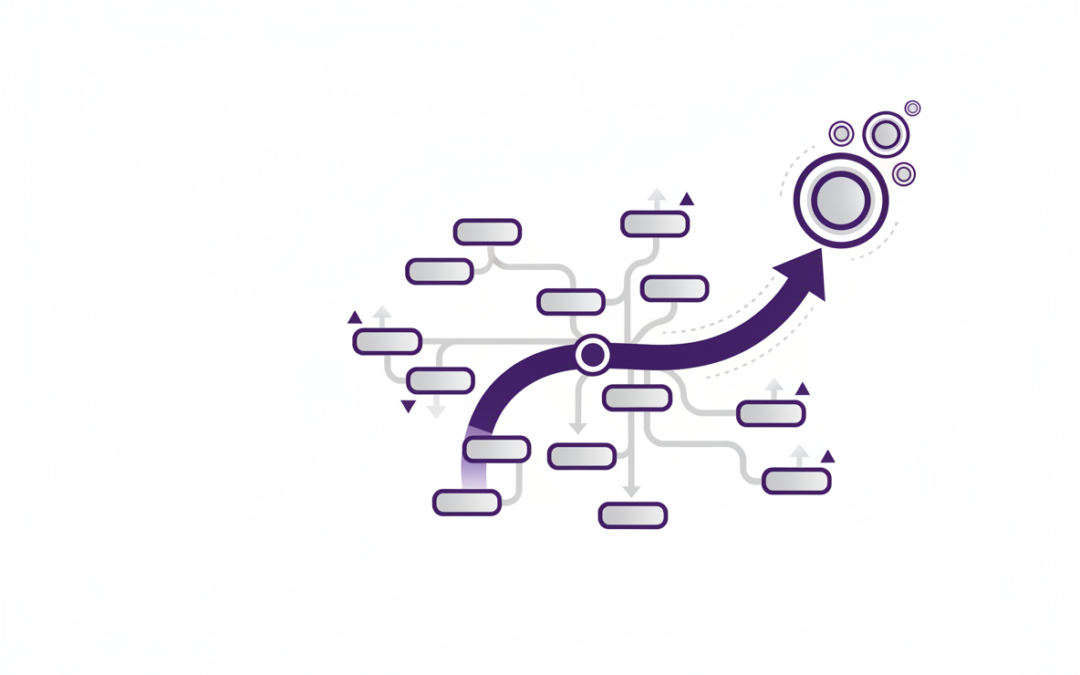
Process Architecture That Grows With Your Business
Most small businesses don’t “break” because the idea is bad. They break because the business grows faster than the way work gets done.
One day, you’re handling enquiries in your inbox. Next, you’ve got multiple channels, multiple team members, and customers expecting consistent quality, every time. If your delivery depends on who’s having a good day, you’re not running the business you truly want. You’re running on best effort without the rewards you probably desire.
This is where process mapping helps, but not as a dusty corporate exercise. Done properly, with understanding and commitment, it’s a practical way to scale without losing your mind.
What process mapping really does (and why it matters when you scale)
Process mapping is simply writing down how work flows from “trigger” to “done.” The value isn’t the diagram itself. The value is the clarity it creates.
When you map a process, you can:
- Spot delays, handoffs, and rework (the hidden time-wasters)
- Make quality repeatable (so customers get the same standard every time)
- Train someone faster (because the steps are visible)
- Reduce dependency on one person’s memory
- Improve the process on purpose, not by accident
A general observation from working with growing teams: most operational stress comes from unclear ownership and unclear “what happens next.” A map fixes both.
Start with process architecture: the “map of maps”
If you only map individual tasks, you can end up with a folder full of diagrams and still feel stuck. Process architecture is the bigger picture: how your main processes fit together.
Think of it like this:
- Architecture = the business-level view (your core value chain)
- Process maps = the detailed “how we do it” for each part
A simple process architecture for a service business might look like:
- Marketing & Lead Generation
- Sales & Onboarding
- Service Delivery
- Customer Support & Retention
- Finance & Admin
- People & Capability (even if it’s just you today)
You don’t need a fancy framework. You need a clear list of the big “end-to-end” flows that keep the business alive.
Practical example: a smaller business preparing to hire
If you’re at the smaller end of small business, you might think “process architecture is overkill.” It isn’t. It’s how you make hiring possible.
- Without architecture, you hire someone and then spend weeks answering questions.
- With architecture, you can say: “Here are the six core areas. You’ll own this one. These are the key processes inside it.”
That’s the difference between adding capacity and adding chaos. Pick one process to map first: choose the one that causes the most pain. If you try to map everything at once, you’ll stall. Instead, start with the process that:
- Creates the most customer frustration
- Eats the most time
- Causes the most errors or rework
- Blocks growth (you can’t take on more work without it)
For many businesses, the best first map is one of these:
- Enquiry-to-quote
- Quote-to-cash (getting paid smoothly)
- Customer onboarding
- Service delivery end-to-end
- Handling customer issues/complaints
A quick mapping method (plain English, no fluff)
Open a blank page and write:
- Trigger: What starts this process?
- Outcome: What does “done” look like?
- Steps: What happens, in order?
- Owner: Who is responsible for each step?
- Inputs/Tools: What’s needed to complete the step?
- Decision points: Where do we choose A vs B?
Keep it simple. You can always make it prettier later.
Improve continuously: small changes, done often, beat big redesigns
“Continuous improvement” sounds like a big programme. In reality, it’s a habit: making small, sensible changes based on what you learn.
Here’s a lightweight approach that works well for small teams:
1) Add a “friction log” to your process
Every time someone says:
- “Why do we do it this way?”
- “I can’t find the latest version.”
- “We always have to chase the customer for this.”
- “This step takes forever.”
…write it down under the process map.
2) Improve one thing per week
Pick the smallest change that reduces friction the most. Examples:
- Add a checklist to reduce missed steps
- Create a template email to speed up responses
- Define what “good” looks like (quality criteria)
- Remove a duplicate approval
- Clarify who owns the handoff
3) Lock the learning in
If you improve the process but don’t update the map, the improvement disappears the next time someone new joins—or the next time you’re under pressure.
A process map is not paperwork. It’s your business memory.
Scaling with process: the four “make it repeatable” levers
When a business scales, volume increases. That means small inefficiencies become big problems. If you want to scale without burning out, focus on making work repeatable using these four levers:
- Standard steps: the minimum set of steps that must always happen
- Templates: emails, proposals, reports, and documents that reduce thinking time
- Checklists: simple quality control that prevents rework
- Clear roles: who does what, and who decides when there’s a problem
Practical example: onboarding a new client. A mapped onboarding process might include:
- Welcome email sent within 24 hours
- Collect required information (with a single form)
- Confirm scope and timeline
- Set up access to tools
- Schedule the first working session
- Confirm the “definition of done” for the first milestone
This doesn’t remove the human touch. It protects it. When the basics are handled consistently, you have more time to be genuinely helpful.
Common mistakes (and how to avoid them)
A few traps I see regularly:
- Mistake 1: Mapping the “ideal” process instead of the real one. Start with what actually happens today. Then improve it.
- Mistake 2: Making it too complex. If a map needs a training course to understand, it won’t get used.
- Mistake 3: Forgetting the customer outcome. Every process should connect to a clear customer result: speed, quality, clarity, or confidence.
- Mistake 4: No ownership. If nobody owns the process, nobody improves it.
Conclusion: Process mapping is how you scale on purpose
You don’t need more hours. You need clearer work.
Process mapping gives you a practical way to see how your business runs, improve it steadily, and scale without relying on memory, heroics, or constant firefighting.
We’re Here To Help
If you want help mapping your key processes—so you can grow with confidence—Map Your Process can support you. We’ll help you get clear on what’s happening, simplify what’s not working, and build a process architecture that makes scaling feel manageable. Your first move could be a lot worse than reaching out to us here.