
A Plain English Guide to Process Mapping That Actually Gets Used
Most businesses, on balance, work hard. But working hard isn’t the only answer, which is why so many struggle because the work is messy: tasks live in someone’s head, handovers are unclear, and the same problems keep showing up in different places.
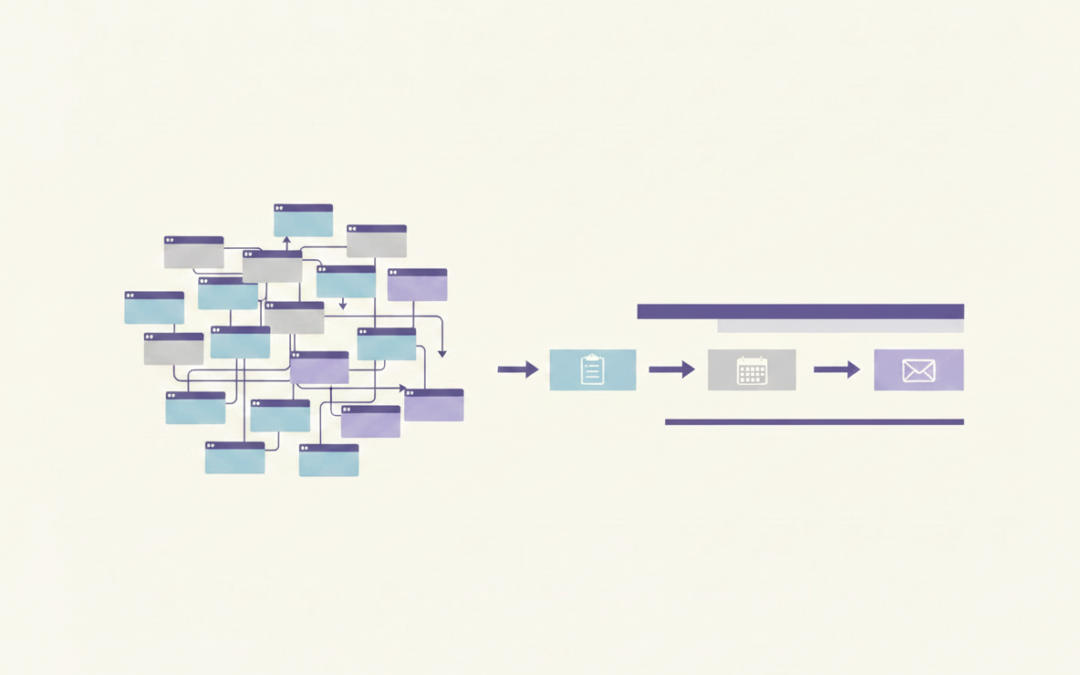
Process mapping is the simplest way to turn “we’ll figure it out” into “we know what happens next.” And done properly, it doesn’t create paperwork; it creates clarity.
What process mapping really is (and what it isn’t)
A process map is a clear picture of how work moves from start to finish.
It isn’t a 40-page manual. It isn’t a fancy diagram that only one person understands. And it definitely isn’t something you do once and forget.
A useful process map answers plain questions:
- What triggers this process?
- What are the steps, in order?
- Who does each step?
- What tools or templates are used?
- What “done” looks like at each stage?
- Where does it commonly go wrong?
If your map doesn’t help a new team member do the work (or help an existing team member do it faster with fewer mistakes), it’s not finished.
Start with one process that’s costing you time (not the whole company)
The biggest mistake is trying to map everything at once. That’s how process mapping becomes a “project” that never ends.
Instead, pick one process that is:
- Frequent (happens weekly or daily)
- Painful (causes delays, stress, or rework)
- Visible (customers notice when it goes wrong)
Good starting points for most small businesses:
- Handling new enquiries
- Creating and sending quotes
- Onboarding a new client
- Delivering your core service
- Managing complaints or refunds
Practical example: mapping “new enquiry to booked call”
Let’s say you’re a service business and you want to turn enquiries into booked calls.
A simple first map could look like this:
- Enquiry arrives (website form / email / social message)
- Enquiry is logged (CRM or spreadsheet)
- Customer gets a response within 24 hours
- Qualification questions are asked (budget, timeline, fit)
- Booking link is sent
- Call is booked and confirmed
- Pre-call questionnaire is sent
That’s already enough to spot common issues:
- “Logged” step is skipped when you’re busy
- Response times vary depending on who sees it first
- Qualification questions aren’t consistent
- Calls get booked without the right prep
You don’t need a perfect map to get value. You need a visible map.
The 3-layer approach: map the work, then tighten it, then improve it
If you want process mapping to lead to real improvement (not just documentation), use this simple three-layer approach.
Layer 1: Map what actually happens
This is not the “ideal” process. It’s the real one.
- Ask the people doing the work to walk you through it
- Capture the steps as they are, including workarounds
- Note where decisions happen (yes/no, approve/reject)
Layer 2: Tighten the process (reduce variation)
Once the steps are visible, look for places where the process changes depending on mood, memory, or who’s on shift.
Tightening doesn’t mean making it rigid. It means making it reliable.
Quick wins:
- Create a simple checklist for the process
- Standardise templates (email replies, quote format, onboarding pack)
- Define “minimum standard” response times
- Clarify ownership at handovers (who is responsible next?)
Layer 3: Improve the process (small changes, often)
This is where continuous improvement lives.
Instead of big “transformation programmes,” aim for small improvements that remove friction:
- Remove steps that don’t add value
- Automate low-risk admin tasks
- Add a quality check where errors are common
- Reduce back-and-forth by gathering info earlier
A healthy process is one that keeps getting better because you keep learning.
Process architecture: how to stop your maps becoming a random pile
Once you’ve mapped a few processes, you’ll notice a new problem: you’ve got lots of maps, but no structure.
That’s where process architecture comes in.
In plain English, process architecture is how you organise your processes so they make sense as a system.
A simple way to structure it is:
- Core processes: the work that delivers your product/service (what customers pay for)
- Support processes: things that enable delivery (finance, hiring, IT, marketing)
- Management processes: planning, performance reviews, decision-making
Why this matters when you’re scaling
When you scale, you add people, tools, and customers. Without a clear architecture:
- Two teams build two different ways of doing the same thing
- New hires get trained differently depending on who’s available
- Problems repeat because nobody owns the “end-to-end” view
With a simple architecture, you can:
- See where a process starts and ends
- Spot duplicated work
- Decide what to standardise across the business
- Prioritise improvements based on customer impact
Scaling with process: the “handover test” every business should pass
Here’s a useful test.
If you had to hand your business to a capable person for two weeks, could they keep it running without constant messages?
If the answer is “no,” it doesn’t mean you’re doing anything wrong. It means your business is still relying on you as the process.
Process mapping helps you move from:
- Hero-based delivery (one person saves the day)
to:
- System-based delivery (the work gets done the same way, even when someone is off)
A practical scaling example: onboarding a new team member
If your onboarding is “shadow me and ask questions,” it works—until you’re busy.
A mapped onboarding process can include:
- Day 1 checklist (accounts, tools, access)
- “How we work” guide (communication, response times, expectations)
- Role-specific training steps
- First-week tasks with clear outputs
- A simple feedback loop (what was confusing? what was missing?)
That’s how you scale without burning out.
Conclusion: keep it simple, keep it useful
Process mapping isn’t about creating bureaucracy. It’s about creating a business that runs smoothly, consistently serves customers, and doesn’t rely on a single person to remember everything.
If you start small, map what’s real, tighten the basics, and improve little by little, you’ll feel the difference quickly.
Action Point
If you want help mapping the processes that are slowing you down and turning them into simple, usable systems, Map Your Process can help.
Whether you’re a solo founder trying to reduce chaos or a growing team that needs consistency, we’ll work with you to:
- Map the processes that matter
- Clarify roles and handovers
- Build practical checklists and templates
- Create a simple process architecture that supports growth
Ready to make your business easier to run? Get in touch with Map Your Process.