
Where Profit Leaks Out of SMEs
Most leaders can spot waste inside a team: duplicated work, unclear priorities, too many meetings. But the most expensive waste in an SME often lives between teams.
It’s the handoffs.
A handoff is any moment where work, information, or responsibility moves from one person (or team) to another. Quoting to delivery. Sales to operations. Operations to finance. Finance to customer service. Customer service, back to operations.
Each handoff is a chance for delay, misunderstanding, rework, and customer frustration. And because handoffs sit “between” functions, they’re easy to ignore, that is, until they start leaking profit.
Why handoffs are so costly (even when everyone is working hard)
In growing businesses, people get busy. Systems multiply. Roles specialise. That’s normal.
The problem is that specialisation increases the number of handoffs, and every handoff introduces friction:
- Time lost waiting for the next person to pick it up
- Missing or inconsistent information
- Different interpretations of “done”
- Rework when something is misunderstood
- Escalations when nobody is sure who owns the next step
The result is a business that feels busy but not better.
The 5 most common handoff failure modes (and how they show up)
1) The “missing context” handoff
What it looks like:
- A lead is passed to delivery, but requirements are vague
- A customer issue is escalated, but the history isn’t included
- Finance receives an invoice request without the right PO or approval
What it costs: delays, back-and-forth emails, and errors that only surface later.
Fix: define a minimum information standard: “A handoff isn’t complete until these fields are present.”
2) The “unclear ownership” handoff
What it looks like:
- Two people assume the other is chasing the customer
- A task sits in a shared inbox for days
- Work bounces between teams because it’s not clear who decides
What it costs: waiting time and frustration (internally and externally).
Fix: assign a single owner per stage, even if multiple people contribute.
3) The “definition mismatch” handoff
What it looks like:
- Sales says “closed,” delivery says “not ready”
- Ops says “complete,” finance says “not billable yet”
- Customer service says “resolved,” customer says “not fixed”
What it costs: rework, disputes, and customer churn.
Fix: agree what “ready” and “done” mean at each stage. Write it down in plain English.
4) The “tool gap” handoff
What it looks like:
- Information lives across email, spreadsheets, WhatsApp, and a CRM
- People retype the same data into multiple systems
- Nobody trusts the ‘single source of truth’
What it costs: errors, duplication, and slow onboarding for new staff.
Fix: don’t start with new software. Start by mapping what information is needed, where it should live, and who updates it.
5) The “exception explosion” handoff
What it looks like:
- “This customer is different” becomes the norm
- Every job needs a special approval
- People rely on tribal knowledge to handle edge cases
What it costs: unpredictable delivery, inconsistent quality, and constant firefighting.
Fix: capture the top 5 exceptions and decide: standardise, automate, or create a clear escalation path.
A quick diagnostic: count your handoffs (and find your profit leaks)
Here’s a simple exercise you can do in 30 minutes.
Pick one core workflow (for example):
- Lead to quote
- Quote to cash
- Customer onboarding
- Service delivery
- Complaints handling
Now answer these questions:
- Where does the process start (the trigger)?
- Where does it end (the outcome)?
- How many times does work change hands?
- At which handoff do things most often stall?
- Where do you see the most rework or “chasing”?
Rule of thumb: if you can’t name the worst handoff immediately, it’s probably because you don’t have visibility—yet.
The handoff map: a lightweight way to make the invisible visible
You don’t need a big programme to fix handoffs. You need clarity.
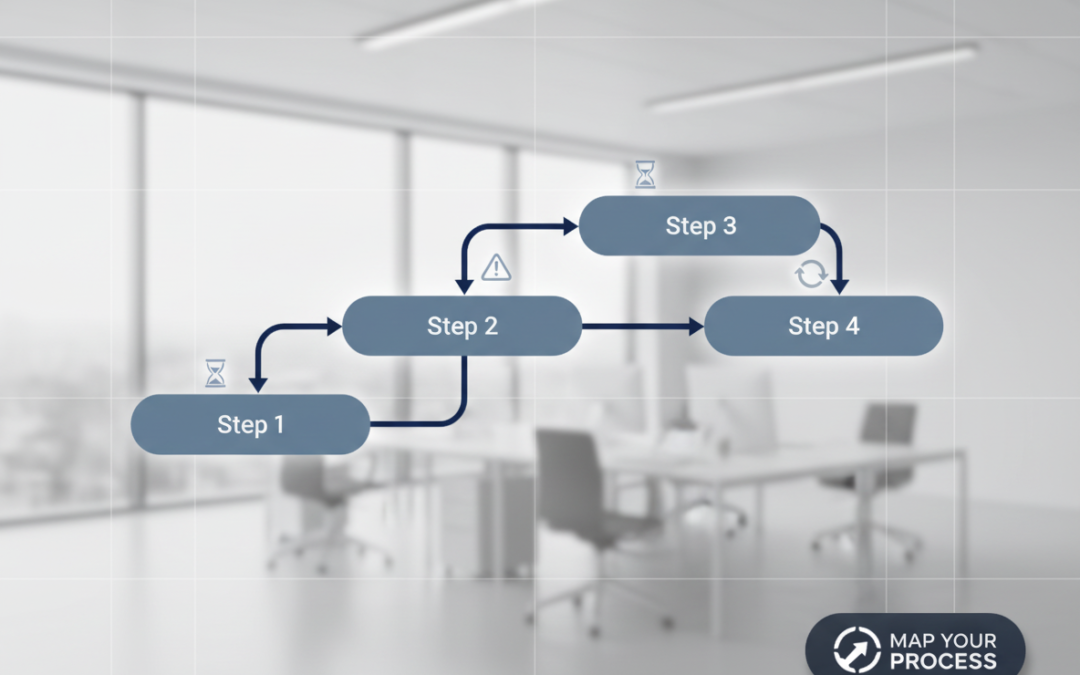
Create a one-page “handoff map” with:
- The stages of the workflow (5–8 stages is plenty)
- The owner of each stage
- The input required to start the stage
- The output required to complete the stage
- The most common exceptions
When you do this, two things happen fast:
- People stop arguing about opinions and start discussing facts.
- Bottlenecks become obvious.
Practical fixes that don’t require new software
Most SMEs can reduce handoff friction dramatically with a few simple interventions.
1) Introduce a “definition of ready”
Before work moves to the next stage, it must meet a minimum standard.
Example: “A job is ready for delivery when the scope is confirmed, the timeline is agreed, and the customer contact details are verified.”
2) Use checklists at the boundaries (not everywhere)
Checklists are most powerful at handoffs because they prevent missing information.
Keep them short. If a checklist has 20 items, nobody will use it.
3) Set simple service levels for internal handoffs
You don’t need a formal SLA document. You need a shared expectation.
Example: “All quote requests are acknowledged within 4 working hours, and either completed or scheduled within 48 hours.”
4) Create a single escalation path
When something doesn’t fit the standard flow, people need to know:
- Who decides
- How quickly they decide
- What information do they need
This prevents exceptions from turning into chaos.
5) Measure one thing that matters
Pick one metric that reflects handoff health:
- Time from stage A to stage B
- Rework rate
- Number of escalations
- First-time-right percentage
Measure it weekly for one month. Improvement becomes visible fast.
A real-world example (simple but common)
Consider “quote to delivery” in a service business.
- Sales agrees on a solution quickly (good).
- Delivery receives the handoff with partial requirements (common).
- Delivery asks questions; the customer waits.
- The start date slips.
- Finance can’t invoice cleanly because the scope changed midstream.
Nobody is incompetent. The process is simply unclear at the boundaries.
Fixing the handoff by defining what must be captured before the job is “ready” often removes most of the friction.
The bottom line: profit leaks where ownership is fuzzy
If your business feels like it’s working hard but not moving forward, don’t start by blaming people.
Start by looking at the handoffs.
They’re where time disappears, quality drops, and customers lose confidence.
Your Call to action: find (and fix) your worst handoff in 30 minutes
If you’d like a fast, practical starting point, book a 30-minute Handoff Leak Check with Map Your Process.
In that session, we will:
- Identify the one workflow that is creating the most delay, rework, or customer friction
- Map the key handoffs on a single page (no big workshop required)
- Pinpoint the worst handoff (where profit is leaking)
- Leave you with 3 clear actions you can implement immediately—without new software
If you prefer to start solo first, run the 30-minute handoff diagnostic in this article and note your answers.
Either way, don’t try to fix everything. Fix the handoff that is costing you the most.
Next step: reply to us with the process you want to tackle (e.g., “quote to delivery”, “onboarding”, “complaints”), and we’ll tell you the best place to start.