
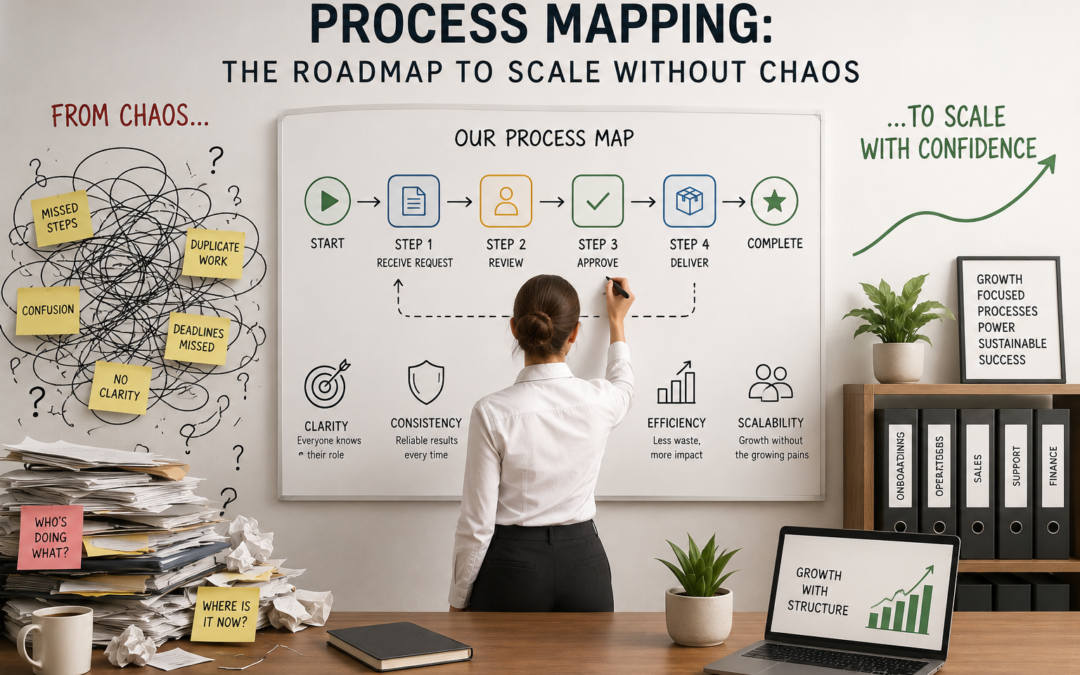
The Simple Answer to Scale Without Chaos
When your business is growing, you’ll feel it first in the cracks: missed follow-ups, inconsistent delivery, “quick questions” that steal your day, and that nagging sense you’re carrying the whole operation in your head or the heads of your key people. In the worst case, those people all have their own ideas about what should happen, which can exacerbate inconsistencies and a lack of clarity.
The good news: you don’t need a massive transformation programme to fix this. You need one clear, repeatable process that turns good intentions into consistent outcomes without turning your business into a bureaucracy, as so often happens in the cases we encounter in our day-to-day operations.
In this short article, we will show you a plain-English way to scale using process mapping, with practical examples you can copy.
The real scaling problem isn’t demand—it’s repeatability
Most businesses don’t struggle because they lack talent or effort. They struggle because success creates complexity:
- More customers mean more handoffs, more messages, more exceptions
- More services mean more “ways we do it”
- More team members mean more training and more inconsistency
- More tools mean more places for work to get lost
Scaling exposes what was previously “fine” when you were small: the invisible steps, the informal decisions, and the reliance on one person (often you) to keep everything moving. A process doesn’t remove flexibility. It removes avoidable confusion.
Start with one “money process” (not everything at once)
A common mistake is trying to map the whole business in one go. That’s overwhelming and usually stalls. Instead, pick one process that directly affects revenue, customer experience, or time. I call it a money process, because improving it pays you back quickly.
Good candidates:
- Lead to booked call (or enquiry to quote)
- Quote to paid invoice
- New client onboarding
- Delivering your core service
- Handling customer issues and refunds
- Content creation and publishing (if marketing is your growth engine)
If you’re unsure which to choose, ask: “Which process, if it ran smoothly every time, would reduce stress and increase results immediately?”
A simple process map you can build in 45 minutes
You don’t need fancy software. Start with a document, whiteboard, or a simple flowchart tool. The goal is clarity, not perfection. Of course, there is an even better option; we would welcome the opportunity to discuss it with you personally.
Here’s the structure we would recommend:
Step 1: Define the start and finish (your boundaries)
Be specific.
Example: “Start = customer requests a quote. Finish = customer pays and receives confirmation.”
This stops scope creep.
Step 2: List the steps exactly as they happen today
Write the real process, not the ideal one. Include the “small” steps; those are usually where delays live.
Example (Quote to Paid) might look like:
- Customer requests quote
- You clarify requirements by email
- You draft quote
- You send quote
- Customer asks questions
- You revise quote
- Customer accepts
- You send invoice
- Customer pays
- You confirm payment and next steps
Step 3: Mark decision points (the “if this, then that” moments)
This is where inconsistency creeps in.
Examples:
- If the customer doesn’t reply within 48 hours, what happens?
- If the job is above £X, who approves it?
- If the customer wants a discount, what’s the rule?
Step 4: Add owners (who does each step)
Even if it’s all you today, write it down. It makes delegation easier later.
Step 5: Add time expectations (simple, not scientific)
No need for “data.” Use reasonable expectations:
- “Reply within 1 business day”
- “Send invoice same day as acceptance”
- “Follow up after 2 days of silence”
This alone can tighten performance.
The “handoff test”: where scaling usually breaks
When businesses grow, work starts moving between people (or between tools). That’s when things get dropped.
Run this quick test on your process map:
- Where does the work move from one person to another?
- Where does it move from one system to another? (email → CRM → spreadsheet → calendar)
- Where does the customer have to provide something before you can continue?
- Where do you rely on memory rather than a trigger?
Those points are your priority areas for improvement.
Practical example: onboarding a new client
A simple improvement is adding a single onboarding checklist that triggers automatically when payment arrives.
Your checklist might include:
- Send welcome email with next steps
- Collect required info (brief, access, assets)
- Book kickoff call
- Create project folder
- Confirm timeline and communication channel
- Set first delivery milestone
This reduces “Where are we up to?” messages and makes the experience feel professional.
Make it scalable: standardise the 80%, personalise the 20%
People worry that processes make them robotic. In reality, the best service businesses do this:
- Standardise what should be consistent (timelines, quality checks, communication steps)
- Personalise what matters to the customer (tone, recommendations, creative choices)
Think of it like a great restaurant: the kitchen has systems, so the customer experience can feel effortless.
A useful way to design this is to split your process into three layers:
- Core steps (must happen every time)
- Options (choose based on customer type)
- Exceptions (rare cases with a clear rule)
This keeps you flexible without being messy.
Continuous improvement: one small upgrade per week beats a big overhaul
Process improvement doesn’t need to be dramatic. In fact, the most sustainable approach is a series of small, constant improvements.
A simple weekly rhythm:
- Pick one process you’re running this week
- Notice the friction (delays, rework, confusion, repeated questions)
- Make one small change
- Document the change in the map or checklist
Examples of “small changes” that create big wins:
- Add a follow-up template for non-responders
- Add a checklist before sending a quote
- Add a “definition of done” for your deliverables
- Add one quality check step before delivery
- Add a standard subject line format so emails are searchable
Over time, you build a business that improves itself.
Conclusion: scaling is easier when the business isn’t trapped in your head
If you want to grow without burning out, you need your business to run on something stronger than memory and effort. A simple process map gives you visibility, consistency, and a foundation you can delegate.
You don’t need to map everything today. Start with one money process, make it clear, and improve it as you go.
CTA: Want help mapping the process that will save you the most time (and protect your customer experience)?
At Map Your Process, we help you turn messy, time-consuming workflows into simple, repeatable processes you can run, delegate, and scale.
If you’re ready to reduce chaos and build a business that runs smoothly, reach out to Map Your Process and let’s map your next best process together.