
The Organisational Understanding Series
Article Three
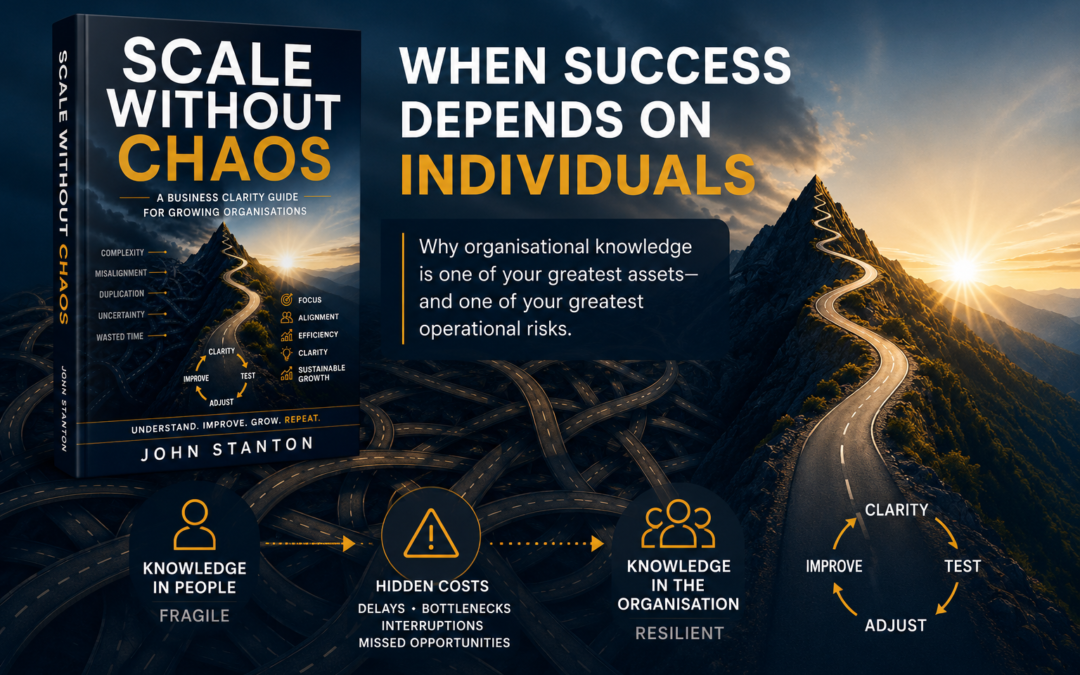
Why organisational knowledge is one of your greatest assets, and one of your greatest operational risks.
In our previous article, When Growth Outpaces Understanding, we explored how successful organisations often become more complex as they grow. New customers, new services, additional teams and changing priorities gradually make it harder for leaders to maintain a clear understanding of how work is really being carried out across the organisation.
As that complexity increases, another challenge often begins to emerge.
It rarely happens because someone makes a poor decision, or because processes suddenly stop working. Instead, it develops naturally, almost unnoticed, as knowledge and experience become concentrated in a relatively small number of trusted individuals.
Every organisation has people like this.
They’re the colleagues everyone turns to when they need an answer. They remember why decisions were made, understand the history behind long-standing customer relationships and know how to navigate situations that aren’t covered by procedures or policies. They solve problems quickly because they’ve seen them before, often long before anyone else recognises there’s an issue.
These individuals are invaluable.
They represent years of experience, practical judgement and organisational wisdom that cannot be learned overnight. Most organisations would rightly describe them as some of their greatest assets.
The difficulty isn’t that these people exist.
The difficulty begins when the organisation quietly becomes dependent upon them.
When Experience Becomes Organisational Memory
Experience has always been one of the greatest advantages any organisation can possess.
It enables better decisions, faster responses and greater confidence. Experienced people understand the subtleties that newer colleagues are still learning. They recognise patterns, anticipate problems and often know instinctively which solution is most likely to succeed.
Good leaders recognise this and work hard to retain experienced people.
The challenge is that experience often remains personal unless the organisation makes a deliberate effort to capture and share it.
Over time, knowledge accumulates in conversations rather than systems.
It lives in notebooks, email inboxes and memories.
It becomes embedded in habits, routines and unwritten ways of working that make perfect sense to those who have been there for years but remain invisible to everyone else.
The organisation gradually develops what might be described as an informal operating system—one that exists almost entirely in the minds of experienced people.
At first, this rarely feels like a problem.
In fact, it often feels like a strength.
- Things get done.
- Customers are looked after.
- Problems are solved quickly.
The organisation appears to be functioning well.
But beneath the surface, something important is beginning to change.
Knowledge is becoming increasingly difficult to access unless you know exactly who to ask.
“Just Ask Sarah”
Most readers will probably recognise the following conversation.
“I’m not sure how this works.”
“Just ask Sarah.”
Or perhaps:
“David dealt with this before.”
“Emma will know.”
“Mike normally handles those.”
Comments like these are completely normal.
They reflect trust, experience and confidence in capable colleagues.
The problem isn’t the conversation itself.
The problem is what it quietly reveals about the organisation.
When the answer to an operational question consistently begins with a person’s name rather than a process’s name, knowledge has begun to become person-dependent.
That dependency usually develops gradually.
Nobody plans for it.
In fact, it often happens because experienced people are helpful.
- They answer questions.
- They solve problems.
- They support colleagues.
- They step in when something unusual happens.
- They become the people everyone trusts.
Ironically, the more capable they become, the more dependent the organisation becomes upon them.
It’s one of the hidden consequences of success.
When Knowledge Becomes a Queue
One of the first signs of organisational dependency is surprisingly easy to spot.
Look at the busiest people in the organisation.
Not the people with the most work.
The people who are interrupted most often.
Their day becomes a constant stream of questions.
- “Can I just ask you something?”
- “Do you remember…?”
- “How do we normally deal with this?”
- “Could you quickly look at this before I send it?”
Each interruption is small.
Each conversation is perfectly reasonable.
Taken individually, none of them seems significant.
Collectively, they create something that quietly slows the entire organisation.
- Knowledge becomes a queue.
- People begin waiting for answers instead of finding them.
- Work pauses while experienced colleagues become available.
- Projects slow down.
- Decisions take longer.
Managers spend increasing amounts of time solving operational questions instead of leading strategic improvement.
The organisation often interprets this as being busy.
In reality, it has become dependent on a limited number of individuals to keep work moving.
This dependency rarely appears on a management report.
There is no dashboard showing “knowledge bottlenecks”.
No monthly performance indicator measuring the number of decisions waiting for one person’s input.
Yet almost every growing organisation experiences it.
Often without realising it.
The Cost You Don’t See
Many organisations only think about knowledge dependency when someone resigns, retires or takes extended leave.
Those events certainly expose the problem.
But they don’t create it.
The real cost begins much earlier.
It appears in the countless small delays that gradually become accepted as “just how things are.”
A new employee takes months rather than weeks to become fully productive because so much of the knowledge they need is passed on informally.
Managers spend their days answering the same questions because there is nowhere else for people to find the answers.
Experienced colleagues postpone their own work to support everyone else’s.
Improvement projects lose momentum because operational issues continually pull key people away from strategic thinking.
None of these challenges feels dramatic in isolation.
Together, however, they create an organisation that becomes increasingly difficult to scale, to improve, and increasingly reliant on the availability of a handful of individuals.
And perhaps the greatest irony of all is this.
The very people who are holding the organisation together often become the people least able to contribute to its future development because they’re too busy helping everyone else with today’s problems.
Dependency Usually Becomes Visible During Change
An organisation can live with person-dependent knowledge for a surprisingly long time.
As long as the right people are available, the work continues.
- Questions are answered.
- Problems are resolved.
- Customers receive what they need.
The dependency remains hidden because capable people continually compensate for it.
Change is usually what exposes the risk.
- Someone goes on holiday.
- A long-serving colleague becomes unwell.
- An experienced manager is promoted into a new role.
- A valued employee retires or leaves for another opportunity.
- A team takes on a major new contract and suddenly needs to deliver the same work at a much greater scale.
At that point, the organisation often discovers that it did not simply lose a person.
It lost access to part of its operational memory.
The difficulty is rarely that nobody can perform the role at all. More often, colleagues know the broad responsibilities but not the practical detail that allowed the work to run smoothly.
They may know what needs to happen but not why it happens in a particular order.
They may understand the official procedure but not the exceptions that experienced colleagues have learned to recognise.
They may know which system to use but not which information can be trusted, which shortcuts create problems later or which stakeholders need to be consulted before a decision is made.
That deeper knowledge is what allows experienced people to exercise judgement.
And judgement is often the first thing an organisation loses when knowledge has not been shared.
A Procedure Is Not the Same as Understanding
Many organisations respond to this risk by writing more procedures.
That can be useful.
Clear instructions help people understand what needs to happen and provide consistency for routine work.
But procedures alone do not create organisational understanding.
A procedure may describe the steps.
It may not explain how the work connects to other teams, why certain decisions matter or what happens when reality does not follow the expected route.
It may tell someone what to do without helping them understand the wider consequences of doing it well, doing it badly or not doing it at all.
This is why organisations can have extensive documentation and still remain dependent on individuals.
The information exists, but the understanding does not.
Sometimes the documentation was written years earlier and no longer reflects how the work is actually performed.
Sometimes different teams maintain their own versions of the truth.
Sometimes procedures explain the ideal process, while experienced employees manage the realities that surround it.
The result is a gap between recorded knowledge and operational knowledge.
That gap is where dependency survives.
Building Organisational Memory
A resilient organisation does not try to remove the value of individual experience.
It does the opposite.
It treats that experience as something worth preserving, sharing and building upon.
Organisational memory begins when individuals’ knowledge becomes visible to others.
That may include the sequence of work, the decisions made along the way, the information required, the people involved and the risks created when something is missed.
It also includes the reasons behind the work.
- Why does this stage matter?
- Why does this team need that information?
- Why does the customer experience depend on a decision made much earlier?
- Why have certain workarounds developed?
- Why do particular problems continue to reappear?
These questions turn activity into understanding.
They allow the organisation to see not only what people do, but how knowledge, decisions and responsibilities move through the business.
That visibility creates a foundation for better training, clearer delegation and more confident decision-making.
It also makes improvement possible.
An organisation cannot reliably improve work that only a handful of people fully understand.
The Aim Is Not to Capture Everything
At this point, leaders sometimes imagine a huge documentation exercise.
They picture months of workshops, lengthy manuals and teams attempting to record every detail of every activity.
That is neither necessary nor desirable.
The aim is not to capture every thought that an experienced employee has ever had.
It is to identify the knowledge the organisation cannot afford to lose.
That usually means beginning with the areas where dependency is already visible.
- Where does work regularly wait for one person?
- Which decisions can only be made by a small number of experienced colleagues?
- Which customer relationships depend heavily on personal history?
- Which roles would be particularly difficult to cover at short notice?
- Where do new starters repeatedly ask the same questions?
- Which processes appear simple until the usual person is unavailable?
These are not merely staffing questions.
They are clues.
They reveal where operational understanding has become concentrated and where the organisation may be more fragile than it appears.
The purpose of exploring those areas is not to make people interchangeable.
It is to make knowledge accessible.
Sharing Knowledge Strengthens Experienced People Too
There is sometimes understandable concern that capturing knowledge may reduce the value of the people who currently hold it.
In reality, the opposite is usually true.
When experienced colleagues are no longer required to answer every routine question, they gain more time to apply their judgement where it matters most.
They can coach others rather than continually rescue them.
They can contribute to improvement rather than simply keeping existing work moving.
They can focus on unusual, complex or strategic challenges instead of repeatedly explaining the basics.
Sharing knowledge does not diminish expertise.
It allows expertise to create greater value.
It also reduces the pressure carried by the organisation’s most dependable people.
Many of those individuals are quietly exhausted.
They are relied upon because they are capable, and because they care. They often accept interruptions, additional responsibilities and constant requests for help because they do not want colleagues or customers to struggle.
Over time, however, being indispensable can become a burden.
The organisation may praise their commitment while unintentionally creating a role that is almost impossible to leave, delegate or develop beyond.
A resilient organisation should not reward its best people by trapping them inside their own knowledge.
Leadership Should Create Capability, Not Dependency
Leaders are often valued for their ability to solve problems.
That ability matters.
But leadership cannot be measured only by how many answers one person holds.
It must also be measured by the capability that exists when that person is not in the room.
The same principle applies throughout the organisation.
A strong manager does not simply become the person everyone depends upon.
They help other people understand, decide and act with confidence.
A strong team does not rely on one colleague to remember everything.
It creates shared ways of working that allow knowledge to survive absence, growth and change.
A strong organisation does not confuse individual heroics with operational resilience.
It makes success repeatable.
That requires a deliberate shift in thinking.
Instead of asking:
“Who knows how this works?”
Leaders begin asking:
“How does the organisation know how this works?”
The difference may appear subtle.
In practice, it is significant.
The first question identifies a person.
The second reveals whether knowledge has become part of the organisation itself.
Resilience Is Built Before It Is Needed
Organisations rarely get advance warning of the moment when person-dependent knowledge will become a serious problem.
- A resignation may be unexpected.
- An illness may be sudden.
- A new contract may require capability more quickly than anticipated.
- A restructure may move experienced people into different roles.
By the time the dependency becomes urgent, the organisation is often trying to recover knowledge under pressure.
That is the worst possible time to begin.
Knowledge transfer is more effective when experienced people are still present, engaged and able to explain not only what they do but why they do it.
It is more effective when the organisation can observe work as it happens rather than attempting to reconstruct it after someone has gone.
It is also more effective when it forms part of normal improvement rather than being treated as an emergency response.
Resilience is not created by hoping important people will stay.
It is created by ensuring their experience continues to strengthen the organisation whether they stay, move roles or eventually leave.
One Question Worth Asking
Consider one of the most experienced people in your organisation.
If they were unavailable for the next six months, what would happen?
- Would work continue with reasonable confidence?
- Would colleagues know where to find the information they need?
- Would decisions still be made at the right level?
- Would customers receive the same standard of service?
Or would part of the organisation’s understanding disappear with that individual?
The purpose of asking this question is not to create anxiety.
It is to reveal an opportunity.
Because the knowledge currently concentrated in experienced people is already one of the organisation’s greatest assets.
The next step is to make sure it becomes an asset the organisation can retain.
From Individual Knowledge to Organisational Understanding
Successful organisations will always need knowledgeable, experienced and trusted people.
That should never change.
The objective is not to make individuals less important.
It is to ensure the organisation becomes stronger because of what those individuals know.
- When experience is shared, capability grows.
- When knowledge becomes visible, decisions improve.
When understanding belongs to the organisation rather than a handful of people, growth becomes easier to manage, and change becomes less disruptive.
Great organisations do not remove the need for experienced people.
They make sure that experience strengthens the organisation rather than becoming a single point of dependence.
Because when knowledge belongs to the organisation, capability is more likely to survive growth, change and the passing of time.
How Map Your Process Helps
At Map Your Process, we help organisations make operational knowledge visible before it becomes operational dependency.
By exploring how work is genuinely carried out, where decisions are made and how responsibilities connect, we help leadership teams build a clearer understanding of the organisation they are running today.
That understanding creates the foundation for stronger resilience, more confident delegation and sustainable improvement.
To begin exploring where knowledge may have become concentrated in your organisation, speak to the Map Your Process team.
The Organisational Understanding Series
This article is part of the Organisational Understanding Series from Map Your Process, exploring how leaders can create greater clarity, confidence and operational capability as their organisations grow.
Previous articles:
Article One: Winning the Contract Is Only the Beginning
Why operational confidence must be built before delivery is tested.
Article Two: When Growth Outpaces Understanding
Why successful organisations gradually become more difficult to see, understand and lead.
Coming Next
Article Four: Better Questions Lead to Better Improvements
Why organisations often rush to solve visible problems before they have understood what is really causing them—and how better questions lead to more meaningful, lasting improvement.
Before you go, there is an additional resource we would like to offer you: our FREE ebook ‘Scale Without Chaos’. You can get your copy by clicking here.