
Why Leaders Need Process Clarity (and How to Get an Advance Copy of Our New E-book)
Most organisations don’t suffer from a lack of effort.
They suffer from effort, pointing in five directions at once.
Operations wants speed. Compliance wants certainty. Finance wants control. Sales wants flexibility. Customer service wants resolution.
Individually, those goals make sense.
Collectively—without a shared view of the work—they create a predictable outcome: handoffs, queues, exceptions, and rework.
That’s not a capability issue.
It’s an architecture issue.
When leaders can’t see the end-to-end system, local fixes create global problems
Here’s what usually happens.
A leader sees a problem in one area and sponsors a sensible fix:
- A new approval step to reduce risk
- A new spreadsheet to “get control”
- A new escalation route to speed things up
- A new policy to standardise decisions
Each fix is well-intended.
But when you don’t have visibility of the end-to-end workflow, those fixes don’t remove friction. They often move it somewhere else.
You reduce risk in one department and increase cycle time in another.
You improve reporting but create duplicate data entry.
You speed up one handoff and overload the next team downstream.
That’s why the symptoms keep returning—just wearing a different outfit.
Two well-known examples of “system thinking” (done well)
We’re not claiming to know the internal details of any brand’s processes. But we can learn from what’s publicly understood about how high-performing organisations think.
Amazon: speed with mechanisms
Amazon is widely associated with speed and customer focus. But speed at scale doesn’t come from “trying harder.” It comes from mechanisms—clear ownership, clear inputs/outputs, and a shared understanding of how work moves.
The lesson: speed is a design choice. Without clarity, speed becomes chaos.
Toyota: standards that enable improvement
Toyota is often referenced for operational excellence and continuous improvement. The point isn’t that standards make a business rigid.
It’s those standards that create a stable baseline—so you can improve without destabilising the system.
The lesson: clarity creates stability, and stability creates capacity for change.
Why process clarity matters most in regulated environments
If you operate in a regulated environment, the cost of unclear processes is higher.
Because uncertainty doesn’t just create delays—it creates risk.
- Risk of non-compliance
- Risk of inconsistent decisions
- Risk of audit pain
- Risk of “shadow processes” (workarounds that nobody documents)
And the most common trap is this: leaders try to reduce risk by adding controls, but without end-to-end clarity, those controls often increase exceptions and rework.
Clarity is how you get both control and flow.
The real goal: immediate process clarity for senior leaders
Senior leaders don’t need 200-page process maps that nobody uses.
They need a clear view of:
- What work actually happens (not what the policy says)
- Where the handoffs and queues are
- Where risk is introduced
- Who owns what (for real)
- What to fix first so improvement doesn’t backfire
That’s what we mean by process clarity.
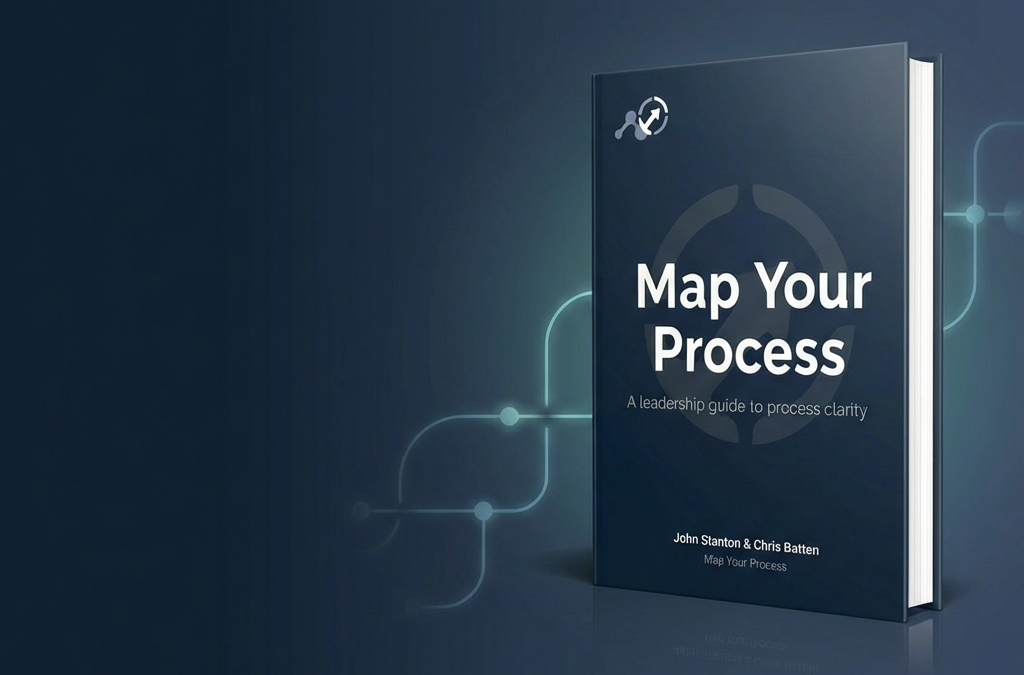
Introducing our new e-book: A Leadership Guide to Process Clarity
This month, we’re releasing a new e-book designed for:
- Operations leaders
- COOs and CEOs
- Senior management teams
- Leaders working in regulated environments
It’s a practical, plain-English guide to getting immediate process clarity—without turning improvement into a never-ending programme.
What’s inside (chapter overview)
- The Hidden Operating System
- Process Architecture in Plain English: Value Streams, Levels & Ownership
- Improvement Starts With You (Leadership Under Scrutiny)
- EQ as Risk Reduction (Yes, Really)
- Change Leadership Without Chaos (A Playbook, With Myth-Busting)
- Resilience: Keeping Standards When It’s Busy
- Process Mapping That Leaders Can Actually Use
- Control Ownership, Measure, & Governance That Hold
- Continuous Improvement Without Destabilising the System
- Prioritise, Sequence, & Execute: The 30/60/90 Roadmap
- Workshops That Surface Reality: Fast, Safe, & Useful
- Sustainable Improvement Culture: Standards Without Burnout
- From Discovery to Delivery: The Strategic Playbook
Want an advance copy?
If you’d like an advance copy of A Leadership Guide to Process Clarity, you can request one now.
All you need to do is provide your preferred email address via the Map Your Process contact page and mention “Advance Copy Request” in your message:
We’ll then email you an advance PDF copy of the book.
Final thought: stop asking people to try harder—give them a shared view of the work
When effort points in five directions, performance becomes unpredictable.
Not because your people aren’t capable.
But because the system isn’t visible.
Process clarity gives leaders a shared view of the work—so speed, certainty, control, flexibility, and resolution stop competing and start aligning.
If you’d like to explore what process clarity could look like in your organisation, reach out for a free, no-obligation chat. We’ll help you identify where the biggest clarity gap is—and what to do next.