
Process Architecture: Where Strategy Meets Daily Work
Whenever I am out and about talking to business leaders from a variety of sectors, businesses of varying sizes and stages of development, most of them have something in common: they are never short on ideas. That said, a good number of them struggle because good ideas don’t reliably translate into consistent results.
That’s where process architecture comes in. It’s the practical “map of maps” that connects your big goals to the day-to-day processes that make them happen—without drowning you in jargon, diagrams, or bureaucracy.
In case you’ve missed our recent posts, here’s our take on what process architecture actually means (in plain English)
If process mapping is drawing a single route, process architecture is designing the entire transport system.
- A process map shows how a piece of work is done (for example, onboarding a new client).
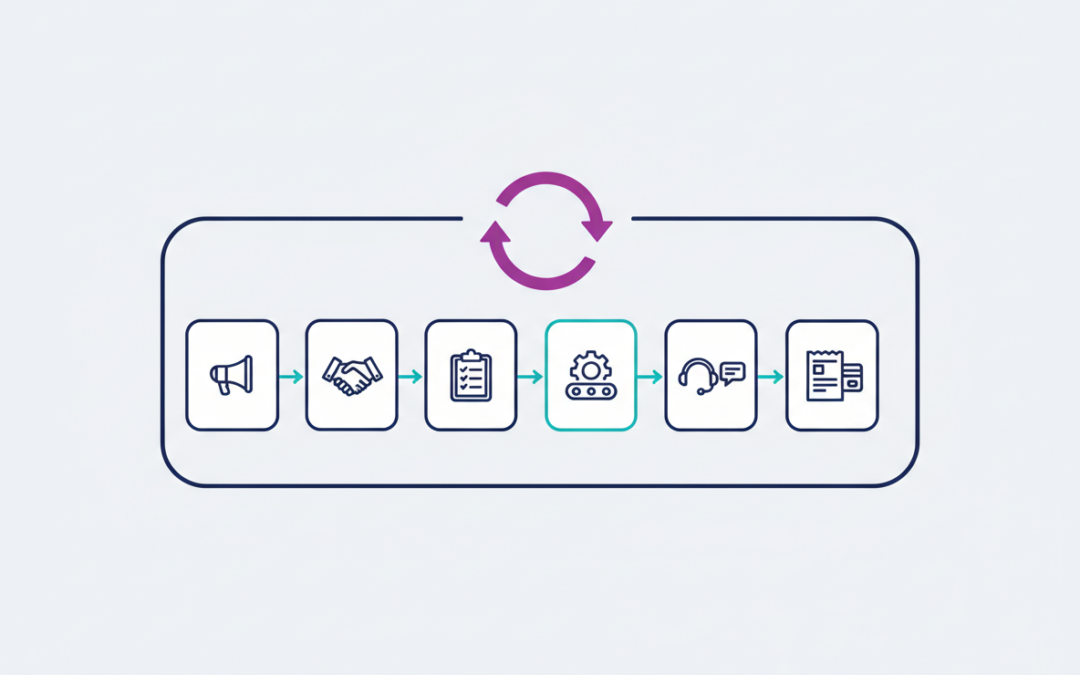
- Process architecture shows how all your key processes fit together (for example: marketing → sales → onboarding → delivery → support → renewal).
It answers questions like:
- What are the core processes that keep the business running?
- Which processes support growth (and which ones quietly slow it down)?
- Where do handoffs happen between people, tools, or teams?
- What should be standardised now, and what can stay flexible?
The goal isn’t to create a pretty diagram. The goal is to reduce confusion, rework, and “tribal knowledge”—so the business runs smoothly even when you’re not in every conversation.
The most common sign you need it: “We’re busy, but it feels messy”
A lot of small businesses hit a point where work increases, but clarity doesn’t.
You may notice:
- Customers get a different experience depending on who serves them
- Tasks fall between the cracks because “someone thought someone else was doing it”
- You keep answering the same internal questions
- You can’t delegate without things coming back to you
- Tools are in place, but the workflow between them is unclear
This is usually not a people problem. It’s a system problem.
Process architecture gives you a simple way to see the system.
A practical way to build a simple process architecture (without overthinking it)
Here’s a straightforward approach you can do on a whiteboard, in a notebook, or in a basic document.
Step 1: List your “end-to-end” value chain
Write the major stages of how you create and deliver value:
- Attract interest (marketing)
- Convert interest (sales)
- Start well (onboarding)
- Deliver the service/product (operations)
- Support and retain (customer success)
- Improve and grow (management)
Keep it high-level. You’re sketching the outline.
Step 2: Add 3–6 key processes under each stage
Example for a service business:
- Marketing
- Content creation
- Lead magnet delivery
- Email nurture
- Sales
- Discovery call
- Proposal creation
- Follow-up and close
- Onboarding
- Welcome email + paperwork
- Kick-off call
- Access and setup
- Delivery
- Weekly client work cycle
- Quality checks
- Reporting
- Support/Retention
- Issue handling
- Review meetings
- Renewal process
You’re not mapping every step yet. You’re defining what needs mapping.
Step 3: Identify the “handoffs” (where things often break)
Handoffs are where work moves between:
- People (sales → delivery)
- Tools (form submission → CRM)
- Time (a follow-up that should happen next week)
These are common failure points because responsibility gets fuzzy.
A simple question helps:
“At this point, who owns the next action—and how do they know?”
If the answer is unclear, that’s a priority area.
Step 4: Choose your first two maps to create
Pick:
- One process that directly affects customer experience (onboarding is a great start)
- One process that directly affects cash flow (lead handling, quoting, invoicing)
This keeps the work grounded in outcomes, not documentation.
Example: how process architecture helps you scale without hiring too early
Let’s say you’re a consultant with a small team (or you’re solo) and you want to grow.
Right now, you might be thinking:
- “I need help.”
- “I need an assistant.”
- “I need to hire someone to deliver.”
Sometimes that’s true. But often, what you need first is a clearer system.
Here’s a realistic scenario:
- You get leads from LinkedIn and referrals.
- Some leads get a quick reply. Others sit for days.
- Discovery calls happen, but notes are inconsistent.
- Proposals are created from scratch each time.
- New clients start, but onboarding varies.
If you hire into that, you’re paying someone to operate a messy workflow.
With basic process architecture, you can standardise the flow:
- A consistent lead capture method
- A defined follow-up cadence
- A proposal template and approval step
- A standard onboarding checklist
Now, when you hire, you’re not just adding capacity—you’re adding capacity into a system that works.
Keep it “alive”: process architecture isn’t a one-time project
A common fear is: “If I document this, it’ll be out of date next month.”
That’s fair—if you treat it like a big compliance exercise.
Instead, treat it like a living management tool.
A simple cadence that works for small businesses:
- Monthly (30 minutes): review one key process. What’s working? What’s causing friction?
- Quarterly (60–90 minutes): review the architecture. Are there new processes? Are old ones redundant?
- Whenever you hire or change tools: update the handoffs and responsibilities.
The aim is not perfection. The aim is clarity.
A quick checklist: is your process architecture “good enough”?
If you can answer “yes” to most of these, you’re in a strong place:
- We can name our core processes without debating for an hour
- We know which processes drive revenue and customer experience
- We know where handoffs happen (and who owns them)
- We have at least two processes mapped clearly end-to-end
- A new team member could understand “how we work” within their first week
If you can’t, don’t worry—this is exactly what Map Your Process is designed to help with.
Conclusion: build the map that makes improvement easier
Process architecture is the missing middle between “strategy” and “today’s work.” It helps you see how the business operates, where it breaks, and what to fix first—so growth feels controlled, not chaotic.
Clear systems don’t remove creativity. They remove avoidable confusion.
If you want a simple, practical way to clarify how your business runs—and identify the first processes to map and improve—Map Your Process can help.
- We’ll define your core process landscape
- Identify the handoffs that cause delays and rework
- Prioritise the first two maps that will make the biggest difference
If you’re ready to make growth feel calmer and more predictable, reach out to Map Your Process and let’s build your “map of maps.”