
Without Drowning in Admin!
Most growing businesses don’t fail because the idea is bad. They stall because day-to-day delivery becomes unpredictable: work takes longer than it should, quality varies, and the founder becomes the “human glue” holding everything together.
That’s where process architecture comes in.
Process mapping is the practical tool most people know. Process architecture is the bigger picture that makes those maps useful, so you can scale with confidence, not chaos.
What process architecture actually means (in plain English)
Think of your business like a house.
- Process maps are the room-by-room layouts (kitchen, bathroom, hallway).
- Process architecture is the floor plan that shows how rooms connect and how people move through the house.
In business terms, process architecture is a simple way to organise your processes so everyone can answer:
- What are the core things we do?
- How do those things connect?
- Where does work start and end?
- Who owns what?
You don’t need a complicated framework or a giant document. You need a clear, shared view of how the business works.
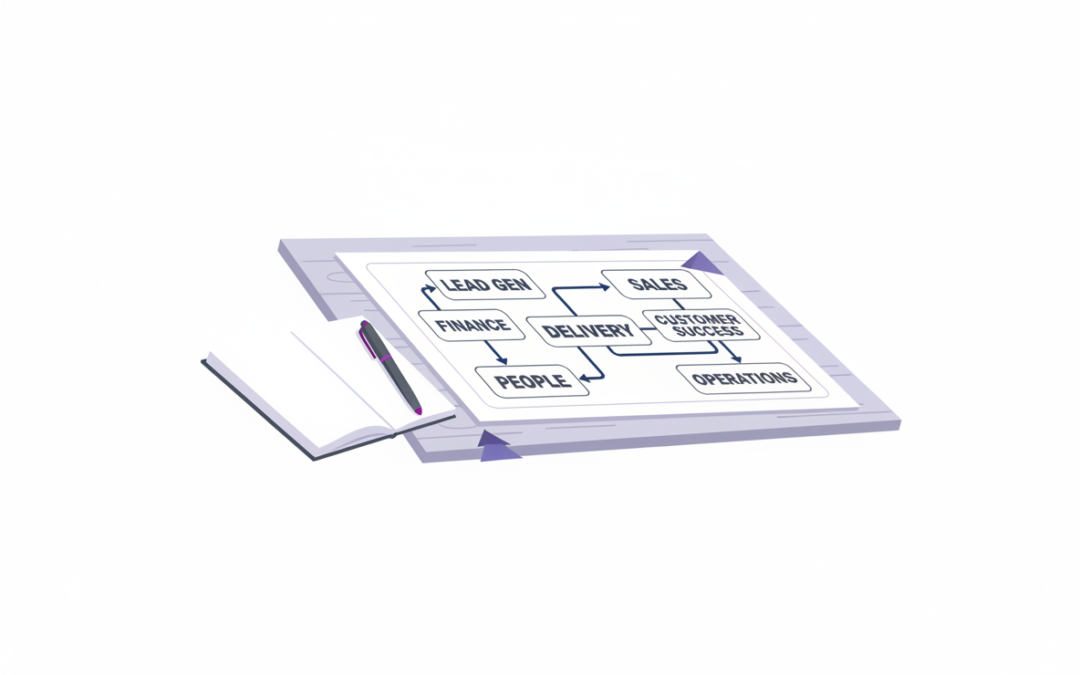
The “One-Page” architecture: start with 5–7 core processes
If you want something you can build in a morning, start here: create a one-page view of your business using 5–7 core processes.
A practical set for many service businesses looks like:
- Lead generation (how people find you)
- Sales (how you convert interest into paid work)
- Delivery/fulfilment (how you do the work)
- Customer success (how you retain, upsell, and get referrals)
- Finance (invoicing, cashflow, reporting)
- People/resourcing (hiring, onboarding, capacity)
- Operations (tools, admin, compliance, internal support)
Now add one line under each: what “done” looks like.
Example:
- Sales: “A signed agreement and a first payment collected.”
- Delivery: “Work completed to spec, approved, and handed over.”
This alone reduces confusion because it creates clear start/finish points.
Where process mapping fits: map only the processes that cause pain
A common mistake is trying to map everything. That turns process work into a never-ending project.
Instead, map the processes that are:
- High frequency (you do them every day/week)
- High risk (mistakes are costly or damage trust)
- High frustration (they rely on memory, heroics, or constant chasing)
- High growth impact (they block sales, delivery, or cashflow)
A practical example: onboarding a new client
Let’s say you’re a consultancy, agency, or professional service.
If onboarding is messy, you’ll see it in:
- late starts
- unclear scope
- missed information
- delays in delivery
- awkward payment conversations
A simple onboarding process map might include:
- Confirm scope and timeline
- Send agreement
- Collect deposit / first payment
- Collect key information (brief, access, assets)
- Book kickoff call
- Set up project workspace
- Confirm first deliverable and due date
You can keep this as a checklist, a simple flow diagram, or a one-page SOP. The format matters less than the clarity.
The scaling benefit: architecture prevents “founder bottlenecks”
When you’re small, you can get away with running the business in your head. When you grow, that becomes a bottleneck.
Process architecture helps you scale because it:
- reduces decision fatigue (people know the next step)
- improves handovers (work moves smoothly between people)
- makes training faster (new starters learn the flow, not just tasks)
- protects quality (key steps don’t get skipped)
- creates accountability (clear owners for each process)
Here’s the key: you don’t need perfection. You need consistency.
If a process works 8 times out of 10, architecture helps you get it to 9 out of 10 by removing ambiguity.
Constant improvement without the overwhelm: the “small upgrades” approach
Continuous improvement sounds like a big programme. In reality, the best improvements are often small and regular.
Try this lightweight rhythm:
- Pick one process per month to review (start with the most painful).
- Ask three questions:
- What’s slowing us down?
- What’s causing rework?
- What’s confusing or inconsistent?
- Make one small upgrade you can implement this week.
Examples of “small upgrades” that compound over time:
- Add a standard email template for booking calls
- Create a one-page client intake form
- Define “ready to start” criteria before work begins
- Add a quality check step before delivery
- Create a simple escalation rule (“If X happens, tell Y within 24 hours”)
This is constant improvement that doesn’t require a department, a consultant, or a huge budget.
A simple exercise you can do today: build your process architecture in 30 minutes
Open a blank page and write:
- How does a stranger become a customer?
- How does a customer receive value?
- How do we get paid and stay profitable?
- How do we support the people doing the work?
Then:
- Group your answers into 5–7 core processes.
- Write a one-line definition for each.
- Identify the one process that, if improved, would make everything else easier.
That last step is your starting point for process mapping.
Conclusion: scale with clarity, not complexity
Process mapping is powerful—but only when it sits inside a clear process architecture. If you can see the whole business on one page, you’ll make better decisions, train faster, and reduce the day-to-day chaos that stops growth.
If you want help building a clear, practical process architecture (and mapping the few processes that will make the biggest difference), Map Your Process can help.
We’ll keep it plain English, focused on real-world delivery, and designed to support growth, without creating a binder that nobody uses.
Ready to bring order to the chaos? Get in touch with Map Your Process and let’s map what matters.