
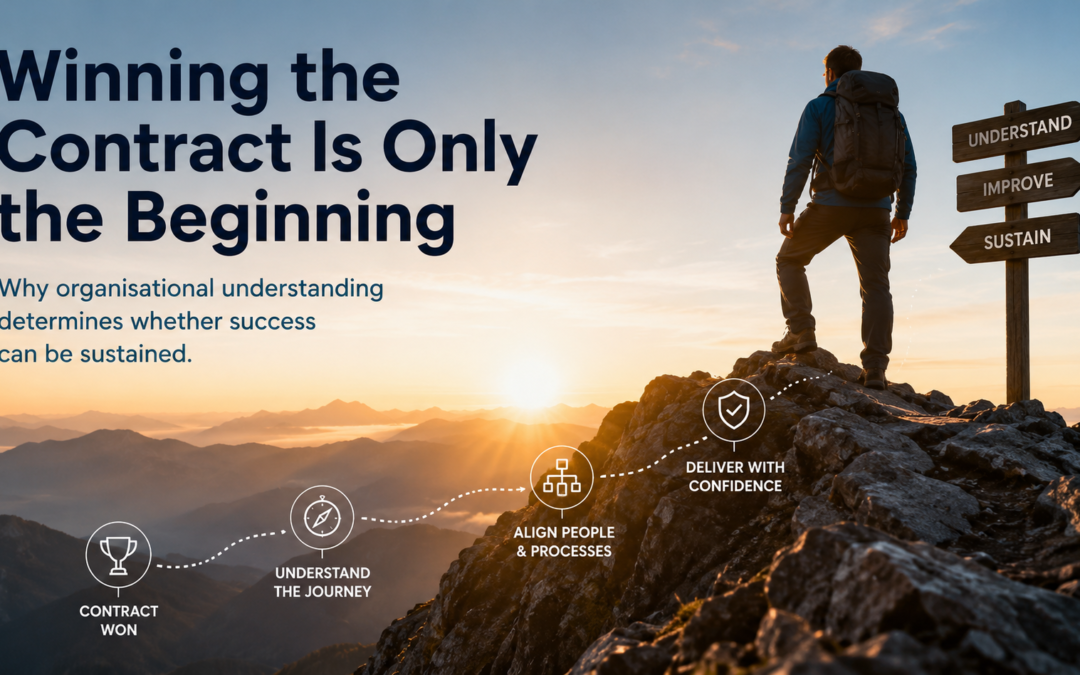
Why organisational understanding determines whether success can be sustained.
Winning a major contract is one of the proudest moments in any organisation’s journey.
Months, sometimes years, of planning, negotiation and hard work have finally paid off. The contract has been awarded, the celebrations begin, and it’s natural to feel that the biggest challenge is now behind you.
In reality, the opposite is often true.
Winning the contract proves that an organisation has convinced someone it can deliver.
Actually delivering consistently, safely and efficiently is something entirely different.
Across every sector, organisations invest enormous amounts of time, energy and expertise into winning new business. Far fewer invest the same effort in understanding exactly how that business will be delivered.
That isn’t a criticism.
It’s simply where attention naturally goes.
Winning is exciting.
Delivery is demanding.
The organisations that consistently deliver on their promises are rarely those that work the hardest once the contract has been signed.
More often, they’re the organisations that already understand how work flows through their business.
The Processes Already Exist
One of the biggest misconceptions about improving organisational performance is the belief that the first step is to create new processes.
In reality, every organisation already has them.
Some are formally documented. Some have evolved over many years. Some are understood only by the people who perform them every day.
The real question is not whether processes exist. The real question is whether the organisation truly understands them.
Can leaders clearly explain how work moves from one team to another?
Where are the critical decision points?
Which activities depend upon others being completed first?
Where are the operational risks?
Where does essential knowledge actually reside?
Until those questions can be answered with confidence, improvement becomes more difficult because leaders are forced to make more decisions based on assumptions than evidence.
Assumptions are an inevitable part of leading any organisation. The objective isn’t to eliminate them completely, but to replace as many unnecessary assumptions as possible with understanding, allowing decisions to be made with greater confidence and less uncertainty.
Organisational understanding begins by identifying the processes that exist, understanding how those processes are actually performed and building a clear picture of how work flows across the organisation.
Only then can leaders improve with confidence.
When Growth Outpaces Understanding
As organisations grow, complexity grows with them.
New customers.
New contracts.
New systems.
New regulations.
New suppliers.
New people.
Each change makes perfect sense on its own. Collectively, however, they create an organisation that is significantly more complex than the one that existed a few years earlier.
That isn’t a failure.
In many respects, it’s a sign of success.
Growing organisations naturally become more complex.
The challenge is that organisational understanding doesn’t always grow at the same pace.
Different teams develop different ways of working. Departments naturally optimise their own activities, sometimes without fully appreciating the impact on those around them.
Knowledge gradually becomes concentrated within experienced individuals.
Decisions continue to be made with the best of intentions, but not always with complete visibility of how work really flows across the organisation.
None of this happens overnight.
It’s usually the result of hundreds of small decisions made over many years. Eventually, leaders begin to notice the symptoms.
Work takes longer than expected. Teams ask the same questions repeatedly. Problems appear in the handovers between departments.
The same issues seem to reoccur despite everyone’s best efforts.
At this point, many organisations assume they have a people problem.
In our experience, that’s rarely the whole story.
More often, they’ve reached the point where the organisation has become harder to understand than it is to manage.
The issue isn’t complexity itself. It’s the gradual loss of visibility that often accompanies growth.
The organisations that respond most successfully aren’t necessarily those that simplify everything. They’re the ones that deliberately rebuild that visibility, enabling leaders to make decisions with greater confidence and fewer unnecessary assumptions.
When Success Starts to Depend on Individuals
Every successful organisation has people who seem to hold everything together. They’re the colleagues others turn to when they need an answer.
They know the customers. They understand the systems. They can spot problems before anyone else notices them.
When something unexpected happens, they’re often the people who find a way through.
Every organisation values people like this, and rightly so.
Their knowledge, judgement and commitment are often a significant part of the organisation’s success.
The challenge isn’t having exceptional people. The challenge is quietly becoming dependent on them. Over time, important knowledge can become concentrated in individuals rather than embedded within the organisation itself.
Processes evolve.
Workarounds are created.
Practical experience grows.
Decisions are made.
Problems are solved.
Much of that knowledge is never written down because, at the time, there seems little reason to do so. The organisation continues to perform well, so the underlying risk remains largely invisible.
It often only becomes apparent when a key person takes annual leave, changes role or leaves the organisation altogether.
Suddenly, simple decisions take longer. Questions that were answered in seconds now take hours or days. Different people provide different answers to the same question.
Progress slows, not because people are less capable, but because the organisation has lost access to knowledge it didn’t realise had become so concentrated.
In our experience, this isn’t a people problem.
It’s an organisational understanding problem.
The objective is never to replace experience or diminish the value of talented individuals.
Quite the opposite.
The aim is to ensure that the knowledge those individuals have developed becomes part of the organisation’s capability rather than remaining solely in their heads.
That doesn’t reduce the value of experienced people.
It increases the organisation’s resilience.
When knowledge is shared, documented and understood, experienced colleagues spend less time answering the same questions and more time applying their expertise where it creates the greatest value.
That’s better for the individual. Better for the team. And ultimately, better for the organisation.
Better Questions Lead to Better Improvements
When organisations recognise that something needs to change, the natural instinct is to look for solutions.
A new system.
A new structure.
A revised procedure.
Additional training.
Sometimes those changes are exactly what’s needed.
The challenge is that it’s remarkably easy to improve the wrong thing if the underlying problem hasn’t been fully understood first.
In our experience, the organisations that improve most successfully rarely begin by asking,
“What should we change?”
They begin by asking a different question.
“How does the organisation really work today?”
That subtle shift often changes the quality of every decision that follows.
Understanding reveals where work genuinely flows well.
It highlights where delays occur.
It exposes unnecessary complexity.
It identifies duplicated effort.
It helps distinguish between isolated issues and systemic problems.
Perhaps most importantly, it allows leaders to challenge assumptions with evidence. That doesn’t mean organisations stop making assumptions altogether.
Every leadership team makes decisions with incomplete information from time to time.
That’s part of leading.
The objective is simply to reduce the number of assumptions that could be replaced by better understanding.
The more clearly leaders understand how work is actually performed, the greater confidence they can have in the decisions they make. That confidence doesn’t come from having all the answers. It comes from asking better questions.
Organisations that invest time in understanding themselves are rarely striving for perfection.
They’re creating clarity. And clarity provides a far stronger foundation for meaningful improvement than urgency ever can.
Capability Is Built Before It Is Tested
Every organisation experiences periods that place greater demands on the business than normal.
Winning a major contract.
Entering a new market.
Integrating an acquisition.
Responding to new regulation.
Implementing significant operational change.
Rapid growth.
Business continuity events.
Each situation is different, but they all have one thing in common. They place existing ways of working under greater pressure. When that happens, organisations rarely have the luxury of stepping back to understand themselves.
They’re expected to respond.
To make decisions.
To solve problems.
To keep moving.
In our experience, the organisations that navigate these periods most successfully are rarely trying to understand how work is performed for the first time.
They’ve already invested time in building that understanding.
That doesn’t mean every process has been documented or every challenge anticipated.
No organisation ever reaches that point.
What it does mean is that leaders have sufficient visibility to make informed decisions with confidence and adapt as circumstances change.
Preparation is not about predicting every eventuality. It’s about creating an organisation that understands itself well enough to respond when circumstances inevitably change.
Whether the challenge is growth, operational transition, a major contract or an unexpected disruption, the principle remains the same.
The better an organisation understands how work is really performed, the more confidently it can respond when that understanding is tested.
Readiness is the outcome of the understanding, clarity and organisational capability that has been built over time.
The Organisations That Consistently Deliver Know Themselves Best
One observation appears repeatedly across organisations that consistently deliver well.
They aren’t always the biggest.
They don’t always have the largest budgets.
And they certainly don’t have all the answers.
What they do have is a clear understanding of how work is performed across their organisation.
They know where responsibilities sit.
They understand how teams depend on one another.
They recognise where knowledge is concentrated and where operational risks are beginning to emerge.
That understanding doesn’t remove uncertainty.
Business will always involve making decisions with incomplete information, responding to unexpected events and adapting to changing circumstances.
What understanding does provide is a stronger foundation for making those decisions with confidence. It replaces unnecessary assumptions with evidence. It creates visibility where uncertainty previously existed. And it allows organisations to improve with purpose rather than simply reacting to problems as they arise.
Winning a major contract, responding to change or preparing for future growth doesn’t create organisational capability.
More often, it reveals the capability that already exists.
That’s why organisational understanding is not an administrative exercise. Nor is it simply a process improvement initiative.
It is a strategic capability that enables leaders to make better decisions, build greater resilience, and create organisations prepared not just for today’s challenges but for tomorrow’s opportunities.
Winning the contract creates the opportunity.
Delivering on the promises made builds reputation.
The organisations that earn trust year after year are rarely those that work the hardest when pressure arrives.
More often, they’re the organisations that invested time in understanding themselves long before that pressure appeared.
One Simple Question Every Leadership Team Should Ask
If your organisation is preparing for significant change, delivering a major programme, supporting continued growth or simply looking to improve the way it works, it may be worth asking one straightforward question.
How well do we really understand how work is performed across our organisation?
Not how we think it works.
Not how our procedures say it should work.
But how it actually works today.
That simple question often becomes the starting point for better decisions, stronger governance and more confident improvement.
At Map Your Process, we help organisations build that understanding.
We work with leadership teams to identify existing processes, understand how they’re actually performed, and provide the visibility needed to make informed decisions with greater confidence.
If this article has prompted you to reflect on your own organisation, we’d be delighted to continue the conversation.
Not about process maps.
About organisational understanding.
Because every meaningful improvement begins with understanding.